
Important Keys
- Catering transforms food businesses from unpredictable walk-in traffic to reliable, advance-booked revenue. The Australian market demonstrates this opportunity clearly: AUD 1.9 billion in annual value, with corporate catering delivering 25-40% profit margins compared to traditional restaurant operations at merely 5-10%.
- This isn’t simply delivering food. Professional catering encompasses menu planning, preparation, delivery, setup, service, and cleanup—creating comprehensive value that commands premium pricing.
- The key differentiator? Predictability. Advance orders mean guaranteed payment, planned production, and eliminated waste. Corporate clients seeking reliable service will pay appropriately for quality and consistency.
- Success requires proper infrastructure: e-commerce platforms enabling seamless ordering, automated systems ensuring accuracy, and upfront payment processing protecting cash flow. Manual processes fail at scale—technology investment becomes profit protection.
- Your competitive advantage lies not in lowest pricing but in reliability, quality maintenance, and expertise. Educate clients about value, establish transparent pricing, and position yourself as the trusted solution rather than the cheapest option.
- Many food businesses miss this revenue stream entirely, lacking understanding of catering’s distinct operational model. Those who recognise catering as a separate profit centre—with dedicated systems, clear processes, and strategic focus—capture market share whilst competitors struggle with manual inefficiency. The question isn’t whether catering opportunity exists. It’s whether you’ll build the systems to capture it.
Table of Contents
What is Catering?
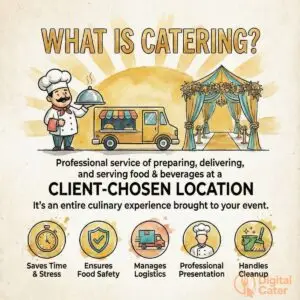
Catering refers to the professional service of preparing, delivering, and often serving food and beverages at a location chosen by the client. Unlike restaurant dining where guests visit an establishment, catering brings the culinary experience directly to your event venue. Professional caterers manage the entire food service operation, from initial menu planning and ingredient sourcing through preparation, transportation, setup, service, and cleanup.
The catering process fits within a larger event ecosystem. Before catering comes into play, you’ve typically secured a venue, set your date, and established your budget. The caterer then works within these parameters to design a menu that reflects your preferences, accommodates dietary restrictions, and aligns with your event’s atmosphere. After the catering service concludes, you’re left with satisfied guests and the freedom to focus on other aspects of your event.
Professional catering delivers several critical advantages that justify its role in successful events. First, it eliminates the enormous burden of cooking for large groups, a task that overwhelms most home kitchens and amateur cooks. Second, caterers bring expertise in food safety, proper storage temperatures, and hygiene standards that protect your guests’ health. Third, they understand timing and logistics, ensuring hot foods arrive hot and cold items remain chilled. Fourth, professional presentation elevates the dining experience, creating visual appeal that enhances enjoyment. Finally, full-service caterers manage staffing, equipment, and cleanup, freeing hosts to engage with their guests rather than worry about logistics.
Catering services meet these standards by solving tangible problems—feeding groups efficiently, safely, and enjoyably. The industry thrives because it addresses genuine needs that alternatives like potluck arrangements or amateur cooking cannot adequately fulfil for larger or more formal occasions.
The Role of a Caterer
A caterer functions as both culinary professional and event partner, managing the complex intersection of food preparation, logistics, client relations, and on-site execution. The position demands technical cooking skills combined with business acumen, interpersonal abilities, and exceptional organisational capacity. Professional caterers don’t simply cook food—they orchestrate comprehensive food service experiences that reflect their clients’ visions whilst maintaining rigorous standards for quality and safety.
Professional caterers typically fulfil multiple critical roles within their operations:
- Event Coordinator: Manages all logistical elements including vendor relationships, timeline development, staff scheduling, and on-site supervision to ensure seamless execution from setup through breakdown.
- Menu Designer: Creates customised food offerings that balance client preferences, dietary restrictions, seasonal availability, budget parameters, and practical preparation constraints whilst maintaining culinary excellence.
- Food Safety Manager: Oversees proper handling, storage, and preparation of all ingredients and finished dishes, maintaining compliance with health regulations and protecting guests from foodborne illness through temperature control and sanitation protocols.
- Client Consultant: Guides clients through planning decisions, translates abstract event visions into actionable meal plans, provides expert recommendations based on venue characteristics and guest demographics, and maintains clear communication throughout the planning process.
- Financial Analyst: Develops accurate cost estimates, tracks expenses against projections, negotiates supplier pricing, manages inventory efficiently, and ensures profitability whilst delivering value to clients.
Core catering responsibilities begin with client consultation, where caterers assess event requirements, discuss menu possibilities, and provide detailed cost estimates. This phase requires active listening and creative problem-solving to translate abstract ideas into concrete meal plans. Menu development follows, balancing taste, visual appeal, dietary restrictions, budget constraints, and practical preparation considerations. Ingredient sourcing demands relationships with reliable suppliers and knowledge of seasonal availability. Preparation work includes both advance cooking that can be done beforehand and on-site finishing that ensures optimal freshness. Transportation logistics require proper equipment, temperature control, and timing coordination. Setup involves transforming raw ingredients and equipment into attractive service stations or plated presentations. Service execution means managing staff, maintaining food quality throughout the event, and adapting to unexpected situations. Finally, breakdown and cleanup restore the venue to its original condition whilst protecting leftover food and reclaiming equipment.
The diagram shows the roles of caterer.

Essential Duties and Responsibilities
Professional caterers execute distinct tasks that separate them from hobbyists or amateur cooks. They design custom menus that balance client preferences with practical preparation limits, seasonal ingredient availability, and budget realities. Recipe scaling transforms home-kitchen quantities into servings for dozens or hundreds whilst maintaining consistent flavour and texture. Precise timing calculations ensure different menu components finish simultaneously, arriving at proper serving temperatures. Staff coordination assigns clear roles to servers, bartenders, and support personnel, maintaining smooth service flow. Vendor management secures rentals for linens, china, glassware, and furniture when venues lack these items. Health code compliance protects guests through proper food handling, storage, and preparation techniques. Budget tracking monitors costs against projections, preventing unwelcome financial surprises. Equipment maintenance keeps cooking gear, transport containers, and serving pieces in reliable working order. Client communication provides regular updates, confirms details, and addresses concerns promptly. On-site adaptability handles inevitable challenges—dietary needs discovered last-minute, equipment malfunctions, or unexpected weather affecting outdoor events.
Strong caterers demonstrate initiative in anticipating problems before they materialise. They calculate quantities conservatively, build extra time into preparation schedules, and maintain contingency plans for common issues. This proactive approach distinguishes professionals from vendors who simply deliver food without considering the broader event context.
The images below shows full role & process of the caterer.

Licensing, Certifications, and Skills
Legal operation requires specific credentials that vary by jurisdiction but typically include business licences, food handler certifications, and liability insurance. Business licences legitimise commercial operations and enable tax collection. Food handler certificates verify training in safe food preparation practices, covering topics like proper cooking temperatures, cross-contamination prevention, and allergen management. Liability insurance protects both caterer and client against accidents or foodborne illness claims. Some regions mandate additional permits for alcohol service, operating commercial kitchens, or transporting prepared foods.
Beyond mandatory requirements, successful caterers cultivate diverse competencies. Culinary technique forms the foundation—knife skills, cooking methods, flavour balancing, and presentation aesthetics. Menu planning requires creativity balanced with practicality, considering what travels well, reheats successfully, and appeals to varied palates. Cost estimation demands mathematical precision, accounting for ingredients, labour, overhead, and desired profit margins. Time management skills prevent bottlenecks, ensuring every component reaches completion simultaneously. Physical stamina supports long hours of standing, lifting heavy equipment, and working in demanding conditions. Interpersonal abilities facilitate client relationships, staff management, and professional interactions with venue coordinators or other vendors. Problem-solving capacity addresses inevitable complications—substitute ingredients for allergies, repair equipment failures, or redesign service flow when spaces differ from expectations. Business knowledge covers pricing strategies, contract terms, marketing approaches, and financial management.
Professional caterers invest continuously in skill development through cooking classes, industry conferences, and hands-on experience with diverse event types. This commitment to growth separates exceptional providers from adequate ones, particularly as client expectations and culinary trends evolve.
Types of Catering Services
Catering services divide into distinct categories based on service style and event type. Understanding these classifications helps clients select appropriate options for their specific needs, matching formality levels, budget constraints, and guest expectations with suitable service models.
By Service Style
Service style determines how food reaches guests—whether through self-serve stations, table service, or delivery without caterer presence. Each approach carries different cost implications, staffing requirements, and experiential qualities.
Full-Service Catering
Full-service catering provides comprehensive event management, handling setup, service, and cleanup whilst maintaining professional staff presence throughout. Caterers arrive early to arrange buffet stations or prepare plating areas, coordinate with venue staff regarding logistics, and ensure all equipment functions properly. During service, trained personnel replenish dishes, clear used plates, manage beverage service, and respond to guest needs. After dining concludes, the team breaks down stations, packs equipment, and removes refuse, leaving the space pristine. This model suits formal weddings, gala dinners, and upscale corporate events where presentation quality and attentive service justify higher costs. Clients appreciate not managing logistics themselves, instead enjoying their event whilst professionals handle operational details. Full-service packages typically include rental equipment, linens, china, glassware, and serving utensils alongside food and staff labour.
Drop-Off & Delivery
Drop-off catering delivers prepared food in disposable or returnable containers without providing service staff or equipment beyond basic necessities. Caterers arrive at scheduled times, unload meal components with heating or serving instructions, and depart before guests arrive. This economical approach works well for casual office meetings, training sessions, or informal gatherings where elaborate presentation matters less than convenience and value. Clients handle setup themselves, arranging food on existing tables or counters and managing service flow. Cleanup responsibility varies—some caterers provide disposable serving pieces and plates whilst others require container returns. The model reduces costs significantly by eliminating staff hours, though it transfers setup and service burdens to hosts. Drop-off service suits situations where food quality matters but formal service doesn’t, typically serving groups of 10 to 50 people in familiar, low-pressure environments.
Buffet-Style
Buffet-style catering establishes self-serve stations where guests select portions from displayed options, balancing variety with efficient service for larger groups. Caterers arrange multiple dishes along tables or counters, providing serving utensils, plates, and condiments for independent selection. Staff presence varies from minimal monitoring to active replenishment and guest assistance depending on package level. This format accommodates diverse preferences effectively, letting individuals customise portions and skip disliked items. Buffets facilitate mingling and conversation whilst eating, creating less formal atmospheres than plated service. Food waste reduction becomes possible when guests control portion sizes, though popular items may deplete quickly without attentive monitoring. Buffet stations suit cocktail parties, corporate celebrations, and casual weddings where social interaction matters more than structured dining. Setup requires adequate space for both food displays and guest queuing, plus consideration of traffic flow preventing bottlenecks.
Plated Service
Plated service delivers individually composed courses directly to seated guests, maximising formality and presentation sophistication. Kitchen staff arrange each plate according to precise specifications—protein positioned consistently, garnishes placed artistically, sauces drizzled deliberately. Servers present meals simultaneously to table groups, creating unified dining experiences reminiscent of fine restaurants. This approach requires detailed coordination between kitchen and service teams, timing courses to maintain proper temperatures whilst avoiding rushed or prolonged gaps. Plated dinners suit formal weddings, awards ceremonies, and diplomatic functions where elegance and tradition matter greatly. The format necessitates higher staffing ratios—typically one server per 12-15 guests—and accurate headcounts determined well in advance. Menu complexity affects pricing substantially, with elaborate multi-course progressions commanding premium rates. Guest dietary restrictions require advance notification, allowing kitchen preparation of alternative plates that match timing and presentation standards of standard servings.
Cocktail Reception
Cocktail reception catering emphasises passed hors d’oeuvres and stationary appetiser displays, facilitating mingling over structured dining. Servers circulate throughout event spaces carrying trays of bite-sized items, offering selections to standing or loosely seated guests. Stationary displays provide cheese boards, crudité arrangements, or carving stations for more substantial options. This format supports networking events, gallery openings, and pre-dinner receptions where movement and conversation supersede formal meals. Food items must be finger-friendly, requiring no cutlery and minimal napkin usage whilst remaining substantial enough to satisfy. Service duration typically spans 1.5 to 2.5 hours, providing enough variety to maintain interest without overwhelming capacity. Cocktail receptions demand careful quantity calculations—appetites vary widely when food replaces full meals, and popular items vanish rapidly. Beverage coordination proves crucial, with bars or drink stations positioned strategically throughout spaces to prevent crowding.
Family-Style
Family-style service places large platters and bowls of food directly on dining tables, encouraging guests to serve themselves and pass dishes amongst their group. This approach blends buffet efficiency with plated service’s structured seating, creating communal, intimate dining experiences. Caterers portion foods into table-appropriate quantities, eliminating individual plating whilst maintaining presentation standards. Serving vessels become part of the aesthetic, requiring attractive platters that complement table settings. The format suits rehearsal dinners, family reunions, and corporate team-building events where shared experience enhances social bonding. Portion control becomes more challenging than plated service but simpler than buffets, as caterers calculate needs per table rather than per person. Family-style encourages conversation and relationship-building, as passing dishes naturally prompts interaction. Setup requires adequate table space for multiple serving vessels alongside place settings, potentially limiting menu complexity.
The diagram shows 6 types of catering service style.

By Event Category
Catering needs transform dramatically based on event type, as different occasions demand distinct service approaches, menu styles, and presentation standards. Understanding these category-specific requirements helps clients select caterers with relevant experience and appropriate specialisation.
Wedding Catering
Wedding catering represents the most emotionally significant and financially substantial catering category for most clients. Budget allocation typically consumes 30% to 50% of total wedding expenses, with costs ranging from $50 to $250 per guest depending on service style, menu complexity, and regional market rates. Couples face decisions spanning cocktail hour provisions, dinner service format, late-night snack stations, and dessert presentations beyond the traditional cake. Menu design must accommodate diverse age groups and dietary preferences whilst reflecting the couple’s cultural background or personal tastes. Service timing coordinates with ceremony schedules, photography sessions, and entertainment transitions, requiring precise synchronisation between caterer and other vendors.
Wedding caterers manage several unique challenges that distinguish this category from other events:
- Emotional stakes: Couples invest tremendous personal significance in their reception meal, viewing food quality as a reflection of their hospitality and celebration of their union.
- Family dynamics: Multiple stakeholders contribute opinions on menu selections, creating potential conflicts between couple preferences, parent expectations, and cultural traditions.
- Seasonal constraints: Popular wedding months create capacity limitations, requiring bookings 12 to 18 months advance for premium dates.
- Vendor coordination: Caterers synchronise with photographers for plated presentation shots, DJs for meal service announcements, and venue coordinators for kitchen access and setup restrictions.
- Dietary complexity: Guest lists spanning generations and backgrounds necessitate vegetarian, vegan, gluten-free, kosher, halal, and allergy-friendly alternatives prepared to match standard service quality.
Successful wedding caterers develop expertise in managing these pressures whilst maintaining culinary standards, recognising that their service contributes to memories clients cherish lifelong.
Corporate Catering
Corporate catering prioritises efficiency, professionalism, and reliability over elaborate presentation or personalisation. Business clients value punctuality above all—meetings and training sessions operate on strict schedules where delayed meals disrupt productivity and reflect poorly on event organisers. Menu selections lean towards familiar, broadly appealing options that accommodate diverse preferences without adventurous ingredients that might alienate conservative eaters. Portion sizing balances satisfaction against afternoon sluggishness, avoiding heavy meals that impair post-lunch focus. Presentation standards remain professional but understated, emphasising clean arrangements over artistic flourishes. Pricing structures favour predictability and value, with corporate clients comparing quotes across multiple providers for recurring services.
Corporate catering encompasses several distinct service contexts:
- Working lunches: Delivered meals for 8 to 30 participants in conference rooms, requiring minimal setup disruption and quiet service that permits ongoing discussions.
- Training sessions: Multi-day events demanding varied menus across consecutive meals to prevent monotony whilst maintaining consistent quality and timely delivery.
- Client entertaining: Higher-end presentations for impressing prospects or partners, requiring refined menus and attentive service that demonstrates company sophistication.
- Company celebrations: Holiday parties, milestone achievements, or team-building events combining professional service standards with more relaxed, celebratory atmospheres.
- Executive dining: Small-group meals for senior leadership requiring discrete service, premium ingredients, and accommodation of specific dietary requirements without advance notice.
Corporate caterers build long-term client relationships through consistent execution, developing familiarity with company preferences, building access procedures, and recurring event patterns that enable efficient service delivery.
Social and Private Events
Social catering covers the broad middle ground between formal weddings and corporate efficiency—birthdays, anniversaries, graduations, baby showers, retirement parties, and family reunions. These occasions prioritise personalisation and guest enjoyment over standardised efficiency or elaborate formality. Hosts often request customised menus reflecting personal tastes, family recipes, or thematic elements tied to celebration reasons. Guest counts range from intimate gatherings of 15 to larger celebrations approaching 100, with flexibility for last-minute attendance changes that corporate or wedding contexts rarely permit. Budget consciousness varies tremendously based on celebration significance and host financial capacity, with some clients prioritising food quality whilst others emphasise quantity and variety within tight constraints.
Social event caterers demonstrate versatility across diverse scenarios:
- Milestone birthdays: Celebrating significant ages like 21st, 40th, or 70th birthdays with menus reflecting honoree preferences and demographic expectations of attendees.
- Anniversary parties: Recognising relationship milestones from 10th to 50th anniversaries, often incorporating couple’s cultural backgrounds or recreating wedding menu elements.
- Graduation celebrations: Feeding mixed-age groups including graduates, parents, and grandparents with casual-to-semi-formal presentations matching venue formality.
- Baby and bridal showers: Predominantly female gatherings emphasising attractive presentations, lighter fare, and afternoon tea-style options alongside traditional meal components.
- Religious celebrations: Bar/bat mitzvahs, confirmations, and similar ceremonies requiring cultural competency and potential kosher or halal preparation standards.
Successful social caterers develop reputations through word-of-mouth referrals within communities, as satisfied hosts recommend providers to friends and extended family planning similar celebrations.
Specialty and Themed Catering
Specialty catering addresses niche markets requiring distinctive expertise, equipment, or preparation methods that differentiate providers from general-service caterers. Food trucks bring mobile kitchen capacity directly to event sites, offering casual street-food aesthetics for festivals, corporate gatherings, or wedding cocktail hours. Dietary-specific caterers focus exclusively on vegan, vegetarian, gluten-free, or allergen-friendly menus, developing deep expertise in alternative ingredients and preparation techniques that prevent cross-contamination whilst maintaining flavour satisfaction. Cultural cuisine specialists prepare authentic regional dishes—Thai, Indian, Mexican, Japanese—with traditional techniques and imported ingredients that generic caterers cannot replicate convincingly. Barbecue and outdoor cooking experts manage smoke pits, spit roasts, and open-fire preparation requiring specialised skills and equipment. Dessert-focused caterers concentrate on elaborate sweet tables, custom cakes, or interactive stations like crepe bars and liquid nitrogen ice cream demonstrations.
Specialty caterers fill important market gaps that general providers struggle to address adequately:
- Authenticity demands: Clients seeking genuine cultural cuisine benefit from caterers with relevant heritage, language skills, and traditional preparation knowledge.
- Dietary safety: Severe allergies or medical conditions like celiac disease require preparation environments free from cross-contamination risks that mixed-menu kitchens cannot guarantee.
- Technical expertise: Particular cooking methods demand equipment and experience that general caterers lack—authentic wood-fired pizza ovens, tandoor preparation, or molecular gastronomy techniques.
- Thematic consistency: Events built around specific concepts—1920s speakeasy, tropical luau, medieval feast—benefit from caterers who understand period-appropriate or culturally-aligned food presentations.
- Unique experiences: Interactive food stations, chef demonstrations, or participatory elements require performers comfortable engaging guests whilst maintaining food safety and quality standards.
Specialty caterers command premium pricing justified by their focused expertise, though their market scope remains narrower than generalist competitors serving broader clientele.
The diagram below shows 4 types of catering services by event category.

Catering Costs and Budgeting
Understanding catering expenses requires examining multiple pricing factors beyond simple per-person rates. Costs vary dramatically based on service style, menu complexity, guest count, geographic location, and timing considerations that many first-time clients underestimate. Transparent budgeting prevents financial surprises whilst enabling informed comparisons between competing proposals.
Pricing Models and Hidden Costs
Caterers structure pricing through several common models, each with distinct advantages and potential complications. Per-person pricing multiplies individual meal costs by guest counts, offering straightforward calculations but requiring accurate attendance estimates to prevent overruns or shortages. Rates typically range from $25 to $85 per guest for drop-off or buffet service, $55 to $150 for full-service buffets with staff, and $75 to $250 for plated dinners with multiple courses. Flat-fee pricing establishes total event costs regardless of final attendance, providing budget certainty but potentially wasting money if guests numbers decline. Hourly rates apply primarily to staffing costs, charging $35 to $75 per server per hour plus food expenses calculated separately. Package pricing bundles specific menus, service levels, and rental inclusions at set rates for common event sizes—”Wedding Package for 100″ or “Corporate Lunch for 30″—simplifying decisions whilst limiting customisation flexibility.
Several expense categories exist beyond obvious food costs that clients frequently overlook:
- Service charges and gratuity: Automatic additions of 18% to 22% compensate service staff and support personnel, appearing as separate line items distinct from base food pricing.
- Rental fees: China, glassware, linens, tables, chairs, and serving equipment incur per-item charges when venues lack necessary supplies, easily adding $8 to $25 per guest.
- Delivery and setup fees: Transportation costs and staff time for arranging service stations before events, typically $150 to $500 depending on distance and setup complexity.
- Overtime charges: Service extensions beyond contracted hours trigger premium hourly rates, often 50% above standard charges, when events run long.
- Cake-cutting fees: Many caterers charge $2 to $5 per guest for slicing and plating outside desserts brought by clients, covering labour and disposables.
- Corkage charges: Clients providing their own wine or spirits pay $15 to $35 per bottle for caterer service, chilling, and glassware provision.
- Venue fees: Some venues mandate specific caterers or charge access fees to outside providers, restricting options and inflating total costs.
- Tastings: Advance menu samplings for larger events incur fees from $50 to $200, though many caterers waive charges after booking confirmations.
- Permit and licensing fees: Special event permits, alcohol licences, or health department inspections create administrative costs passed to clients.
Comprehensive contracts detail these expenses explicitly, preventing misunderstandings when final invoices arrive. Clients requesting detailed breakdowns during proposal stages identify providers willing to maintain transparent pricing versus those obscuring true costs through vague estimates.
Budgeting and Saving Tips
Strategic planning reduces catering expenses without compromising quality or guest satisfaction. Seasonal menu selections incorporate ingredients at peak availability and lowest market prices—summer berries, autumn squashes, winter root vegetables—avoiding premium charges for out-of-season imports. Service style choices dramatically impact costs, with buffet presentations requiring fewer staff hours than plated dinners whilst offering comparable food quality. Guest count accuracy prevents over-ordering, as caterers typically prepare 5% to 10% surplus creating waste when attendance estimates exceed reality. Weekday or off-season bookings secure lower rates, as caterers offer discounts for Friday lunches, Sunday brunches, or January through March dates that avoid peak wedding season competition.
Additional cost-management strategies deliver meaningful savings:
- Simplify bar service: Limited wine and beer selections cost substantially less than full open bars whilst satisfying most guest preferences adequately.
- Reduce menu complexity: Three-course meals rather than five courses, or two protein options instead of four, cut ingredient and preparation expenses without diminishing perceived value.
- Provide some elements yourself: Supplying your own dessert, coffee service, or cocktail-hour appetisers reduces caterer scope whilst maintaining control over signature elements.
- Negotiate package inclusions: Bundling multiple services—catering, rentals, staffing—with single providers often yields better total pricing than piecing services separately.
- Adjust guest-to-staff ratios: Buffet service requires fewer servers than plated meals, with acceptable ratios ranging from 1:30 for buffets to 1:12 for formal plating.
- Opt for family-style service: Sharing platters reduces individual plating labour whilst creating intimate dining experiences guests often prefer over formal presentations.
- Schedule strategic timing: Late afternoon or early evening events permit “heavy appetiser” receptions rather than full dinners, cutting costs 30% to 50% whilst maintaining satisfaction.
- Compare itemised proposals: Request detailed breakdowns enabling line-by-line comparisons between competing caterers rather than accepting single bottom-line figures.
Quality catering exists at multiple price points, with savings achieved through informed choices rather than accepting inferior ingredients or inexperienced service staff.
The diagram below shows costs, budgeting & selection strategies.

Choosing the Right Caterer
Selecting appropriate catering requires systematic evaluation beyond attractive menu descriptions or appealing pricing. The process combines credential verification, personal chemistry assessment, and contract analysis to identify providers capable of executing your specific vision reliably.
Screening: Licenses, Insurance, and Reviews
Initial caterer evaluation establishes baseline legitimacy and competence before investing time in detailed consultations. Business licence verification confirms legal operation and tax compliance through local government registries. Food handler certifications demonstrate training in safe preparation practices, with staff holding current permits from recognised health authorities. Liability insurance protections shield clients from financial responsibility for accidents, foodborne illness, or property damage, with minimum coverage typically $1,000,000 for general liability and $2,000,000 aggregate limits. Workers’ compensation insurance protects caterer employees injured during your event, preventing clients from bearing medical costs or lost-wage claims.
Reference checking and review analysis provide performance insights beyond credentials:
- Recent client references: Request contacts for three to five events completed within the previous six months, focusing on similar event types and guest counts to yours.
- Online review patterns: Examine feedback across multiple platforms—Google, wedding directories, business review sites—noting consistent themes in both positive and negative comments.
- Response professionalism: Observe how caterers address complaints publicly, as graceful problem-solving demonstrates customer service commitment.
- Portfolio photography: Review event photos showing actual executed work rather than stock images, assessing presentation standards and style consistency.
- Venue familiarity: Prioritise caterers with previous experience at your specific venue, as site knowledge prevents logistical surprises and kitchen access complications.
- Specialty credentials: Verify claimed expertise in dietary accommodations, cultural cuisines, or service formats through evidence of relevant training or certifications.
Thorough screening eliminates unsuitable candidates early, focusing subsequent evaluation efforts on qualified providers worth detailed consideration.
Consultation Questions & Tastings
Effective caterer consultations uncover compatibility beyond menu preferences, revealing communication styles, problem-solving approaches, and service philosophies that predict successful partnerships. Schedule meetings with your top three candidates, preparing specific questions that expose operational details and contingency planning.
Critical consultation questions include:
- How do you handle last-minute guest count changes? Understand flexibility limits, typically 72 hours before events, and associated cost adjustments.
- What backup plans exist for equipment failures or staff emergencies? Reliable caterers maintain contingency equipment and on-call staff lists.
- How do you accommodate severe food allergies and cross-contamination prevention? Detailed protocols reveal genuine expertise versus superficial awareness.
- What happens if specific ingredients become unavailable close to the event date? Substitution policies and client notification procedures demonstrate proactive communication.
- Can you provide exact staff-to-guest ratios for our service style? Specific numbers indicate experience-based planning rather than vague assurances.
Tasting sessions validate food quality beyond proposal descriptions, letting you sample actual menu items prepared by the team executing your event. Most caterers offer tastings for bookings exceeding $3,000, charging $50 to $200 for smaller events. Evaluate flavour, presentation, portion sizing, and temperature alongside your palate preferences. Bring trusted advisors whose opinions you value, as single perspectives miss elements others notice. Request modifications to sample dishes, observing receptiveness to feedback and creative problem-solving when adjusting recipes.
Comparing Proposals and Contracts
Proposal comparison requires systematic analysis beyond identifying the lowest bottom-line figure. Request itemised breakdowns listing food costs, staff charges, rental fees, and service charges separately. This transparency enables meaningful comparisons, revealing whether apparent savings stem from reduced service quality, smaller portions, or eliminated inclusions rather than genuine efficiency. Calculate true per-person costs by dividing total amounts including all fees by confirmed guest counts, exposing proposals where attractive base rates hide expensive add-ons.
Contract scrutiny protects both parties through clear expectation documentation. Essential contract elements include guaranteed guest count with acceptable variation percentages, typically plus or minus 5%, and associated cost adjustments. Payment schedules specify deposit amounts, interim payment dates, and final balance timing, usually requiring 50% deposits, additional payments 30 days before events, and final balances upon service completion. Cancellation policies outline refund percentages based on notification timing—60 days might yield 75% refunds whilst 14 days forfeits deposits entirely. Menu specifications detail exact dishes, portion sizes, and presentation styles, preventing substitutions without approval. Staffing commitments guarantee minimum server numbers and supervisor presence throughout service periods. Equipment and rental provisions clarify what caterers supply versus client or venue responsibilities. Liability and insurance clauses confirm coverage limits and responsibility allocation for damages or injuries.
Professional contracts address potential complications through force majeure clauses covering natural disasters, venue closures, or pandemic restrictions that prevent event execution. Dispute resolution procedures establish mediation or arbitration requirements before litigation. Amendment processes define how menu changes, guest count updates, or service modifications get documented and approved. Review contracts thoroughly before signing, consulting legal counsel for large-value agreements or unfamiliar terms that create uncertainty.
Planning & Timeline for a Catered Event
Systematic planning prevents oversight whilst reducing decision stress through structured progression. Different event sizes demand varying preparation periods, with intimate gatherings requiring three months whilst large weddings need 12 to 18 months for securing premium vendors and venues.
6–12 Months Out
Early planning establishes foundational elements determining subsequent decisions. Research potential caterers through referrals, online reviews, and venue recommendations, creating shortlists of five to eight candidates. Contact caterers requesting availability confirmation for your date, rough budget estimates for anticipated guest counts, and preliminary menu concepts matching your vision. Schedule consultations with three finalists, conducting tastings and reviewing proposals systematically. Secure your chosen caterer through signed contracts and deposit payments, typically 25% to 50% of estimated totals. Discuss rental needs—tables, chairs, linens, china—determining whether caterers provide items or coordinate separate rental companies. Begin menu development conversations, sharing dietary restrictions, cultural preferences, and vision elements informing dish selections.
3–6 Months Out
Mid-stage planning refines general concepts into specific execution details. Finalise complete menus including appetisers, main courses, sides, desserts, and beverage selections, confirming preparation methods and presentation styles. Provide updated guest estimates enabling accurate quantity calculations and staffing determinations. Communicate all dietary restrictions, allergies, and special meal requirements, allowing preparation of appropriate alternatives. Confirm rental needs finalising quantities for tables, chairs, linens, china, glassware, and serving equipment. Schedule final tastings if significant menu modifications occurred since initial consultations. Review venue logistics including kitchen access, setup timing, parking arrangements, and cleanup requirements. Coordinate with other vendors—photographers, musicians, venue managers—ensuring timeline alignment and space allocation clarity.
Final Month and Week
Late-stage coordination addresses final details and confirms execution readiness. Submit guaranteed guest counts 10 to 14 days before events, understanding that numbers typically lock at this point with financial penalties for increases. Conduct final caterer meetings reviewing complete timelines, special requests, and contingency plans for weather or unexpected complications. Confirm staff arrival times, setup schedules, and service flow including cocktail hour transitions, dinner timing, and dessert presentations. Verify all rental deliveries and pickup schedules, ensuring items arrive early enough for caterer setup without obstructing other vendors. Provide detailed venue layouts showing table arrangements, buffet placements, and bar locations. Review payment procedures confirming final balance amounts, acceptable payment methods, and timing expectations. Create emergency contact lists including caterer supervisors, venue managers, and key family members for day-of coordination.
Common Catering Mistakes to Avoid
Learning from frequent errors prevents costly complications. Underestimating guest counts creates food shortages embarrassing hosts and disappointing attendees, whilst excessive overestimation wastes money on unconsumed meals. Calculate conservatively, adding 5% to 8% buffers accounting for unexpected plus-ones without dramatic oversupply. Poor communication regarding dietary restrictions risks serious health consequences when allergen-free options contain undisclosed ingredients or suffer cross-contamination. Document all restrictions in writing, confirming caterer understanding and preparation protocols during final meetings. Inadequate venue logistics research leads to kitchen access problems, electrical capacity shortages, or parking complications disrupting service flow. Visit venues with caterers beforehand, identifying potential obstacles and developing solutions collaboratively.
Last-minute menu changes disrupt preparation schedules, forcing caterers into rushed ingredient sourcing or recipe modifications that compromise quality. Finalise menus at least 30 days before events, resisting temptation to incorporate trendy ingredients discovered late. Insufficient budget allocation for service staff reduces guest experience quality through slow service, delayed clearing, or inadequate beverage replenishment. Prioritise appropriate staffing ratios even if menu complexity requires reduction to accommodate labour costs within budgets.
Trends and Frequently Asked Questions
Current Catering Trends
Contemporary catering reflects broader food industry movements towards sustainability, health consciousness, and technological integration. Local sourcing emphasises regional ingredients supporting nearby farms whilst reducing transportation environmental impacts. Plant-forward menus increase vegetable prominence without fully eliminating animal products, appealing to flexitarian preferences becoming mainstream. Interactive food stations engage guests through build-your-own options—taco bars, pasta stations, salad assemblies—creating personalised experiences. Technology adoption streamlines ordering through online platforms, coordination via event management apps, and dietary preference collection through digital forms. Sustainable practices reduce single-use plastics, compost food waste, and donate surplus meals to hunger relief organisations, aligning with environmentally conscious client values.
Frequently Asked Questions
How far in advance should I book catering? Secure caterers 6 to 12 months before major events like weddings, particularly for peak season dates between May and October. Corporate and social events permit shorter timelines of 4 to 8 weeks, though popular caterers fill calendars quickly during holiday periods.
What percentage of my event budget should catering consume? Allocate 30% to 50% for weddings where food quality significantly impacts guest satisfaction. Corporate events typically dedicate 20% to 35%, whilst casual social gatherings manage with 15% to 25% depending on priorities.
How do I calculate appropriate food quantities? Professional caterers determine portions based on event timing, duration, and other food availability. Dinner events require 225 to 280 grams protein per person, whilst cocktail receptions need 12 to 15 pieces per guest for two-hour periods.
Can I provide my own alcohol? Many caterers permit client-supplied alcohol charging $15 to $35 per bottle corkage fees covering service, chilling, and glassware. Verify venue alcohol policies and required licensing before purchasing supplies independently.