A café owner in Melbourne turned a $10,000 monthly account into her primary revenue stream within 90 days. She did not hire more staff. She did not spend thousands on advertising. She built a system.
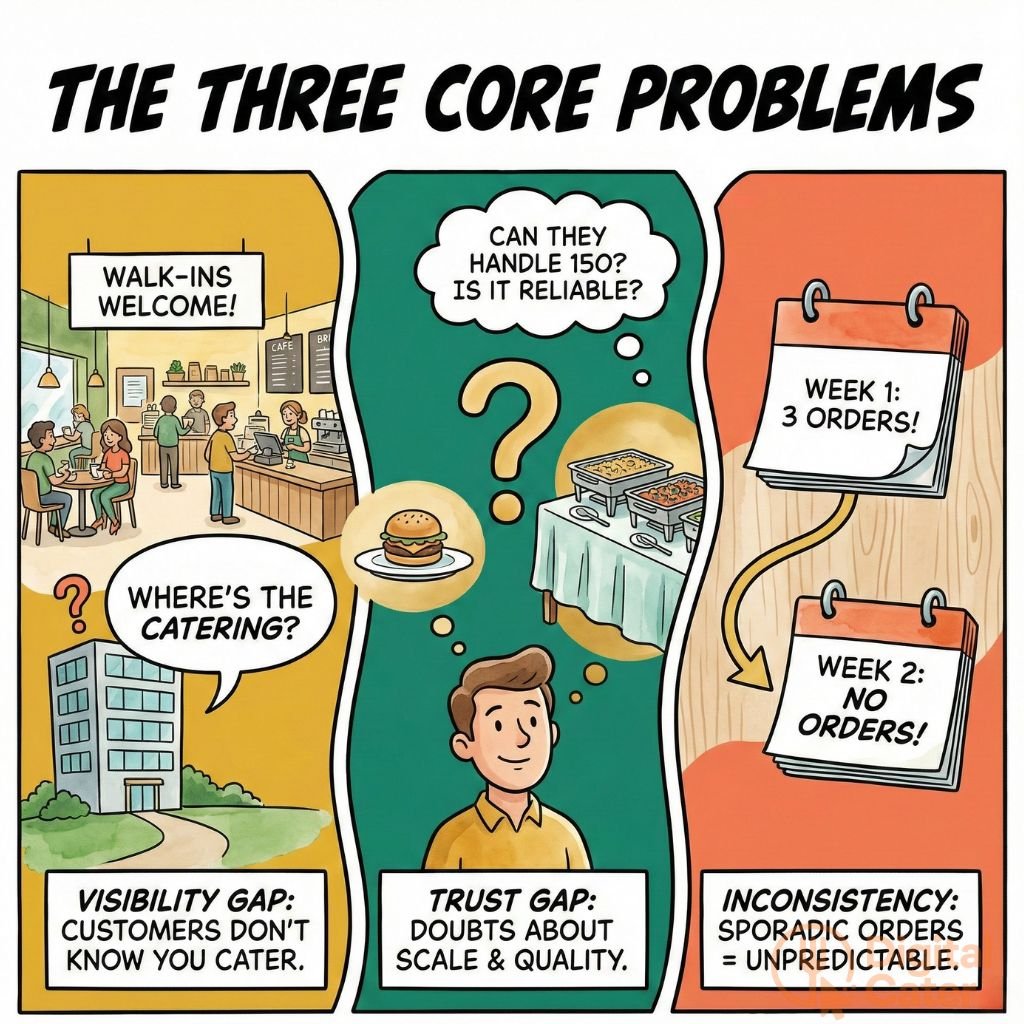
Most food business owners face three problems when growing their catering revenue. First, potential customers do not know you offer catering services. Your restaurant may serve 200 customers daily, yet corporate offices 500 metres away order from competitors. This visibility gap costs you thousands each month.
Second, even when prospects discover your catering menu, they hesitate. Can your kitchen handle 150 meals for their quarterly meeting? Will the food arrive hot and on time? This trust gap prevents enquiries from becoming orders.
Third, orders arrive sporadically. One week brings three corporate lunches. The next week brings nothing. This inconsistency makes staffing, inventory, and cash flow unpredictable.
This guide provides direct sales tactics, operational frameworks, and a structured 90-day implementation plan. The strategies draw from ten years of experience helping food businesses across Australia build, scale, and optimise catering operations. Data comes from dozens of client engagements that generated millions in combined catering revenue.
The goal is measurable. Within 90 days, you can migrate 30% of marketplace orders to direct channels and build toward $25,000 or more in monthly catering revenue. This requires work. It requires consistency. But the path is clear.
Whether you own a bakery, sushi shop, taco restaurant, or established catering business, these principles apply. The economics favour those who build systems rather than chase individual orders.
Table of Contents
Understanding the Catering Opportunity
The catering sector represents one of the most underutilised revenue channels for food businesses. Understanding the economics, barriers, and target markets positions you to capture this opportunity.
The Economics of Catering Growth
The Australian catering market exceeds $10 billion annually. Approximately 75% of corporate catering orders now originate online. This shift creates opportunity for businesses with strong digital presence.
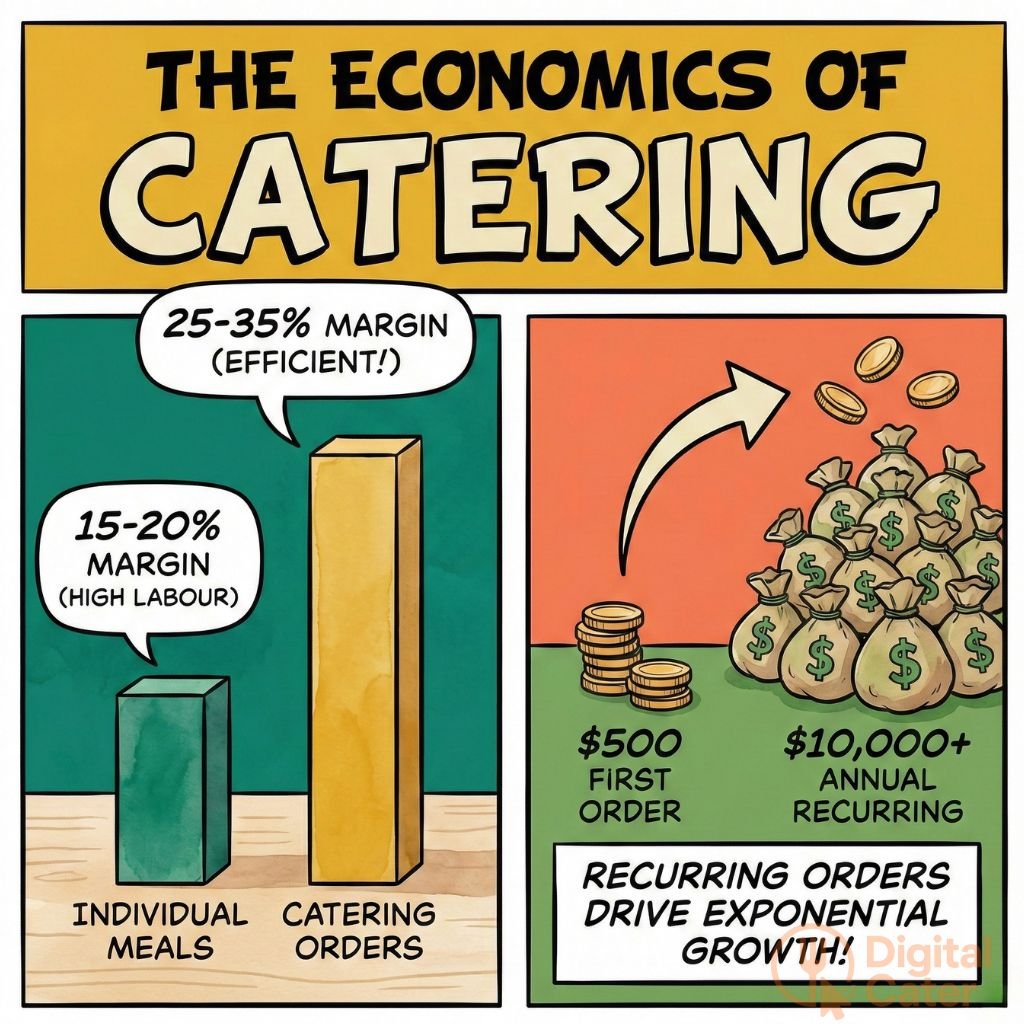
Consider margin differences. Individual meal orders typically yield 15-20% profit margins after labour, ingredients, and overhead. Catering orders deliver 25-35% margins. The efficiency comes from batch production, predictable prep time, and reduced per-unit labour costs.
Customer lifetime value tells the real story. A first-time corporate order averages $500. That same client, when retained, generates $10,000 or more annually through recurring weekly or monthly orders.
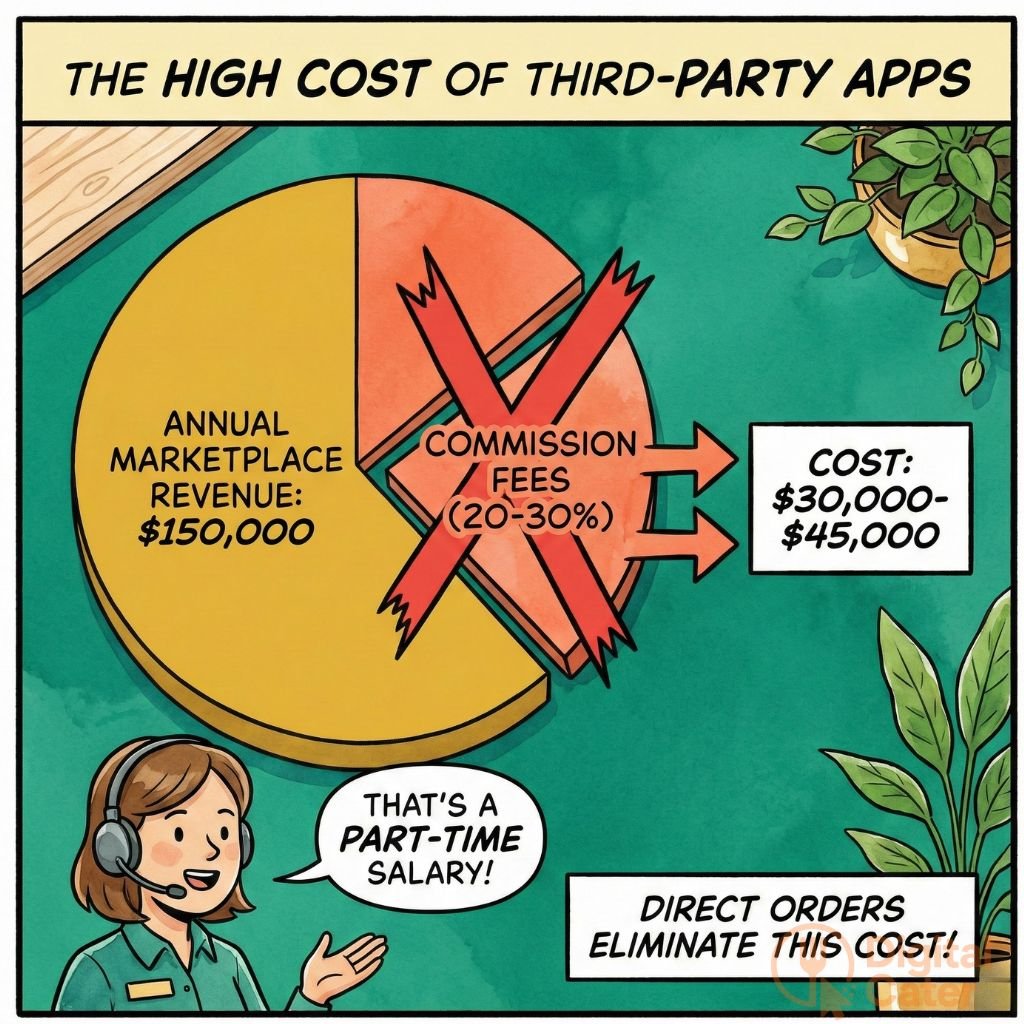
Commission costs compound this advantage. Third-party marketplace fees range from 20-30% per order. For a business processing $150,000 annually through marketplaces, commissions consume $30,000-$45,000. Direct orders eliminate this cost entirely. That represents the salary of a part-time catering coordinator.
Average order values differ dramatically as well. Individual delivery orders average $25-$35. Catering orders average $300 or more. Ten catering clients equal 100 delivery customers in revenue terms, with lower operational complexity.
The Three Barriers Killing Your Catering Sales
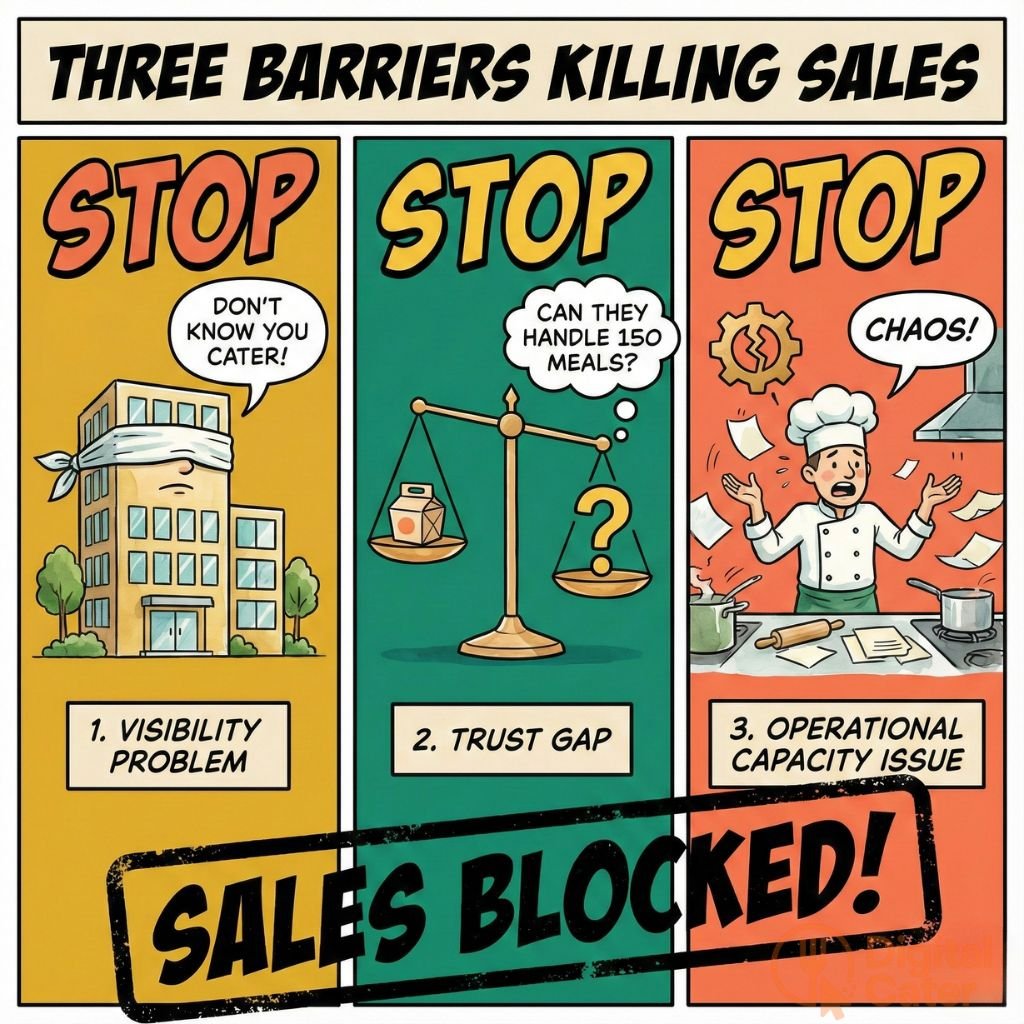
Three obstacles prevent most food businesses from capturing catering revenue.
- The Visibility Problem: Corporate decision-makers within 5 kilometres (3 miles) of your location do not know you cater. Your storefront attracts walk-in customers. Your online presence attracts delivery orders. Neither channel reaches office managers planning next week’s team lunch.
- The Trust Gap: Catering requires scale. Prospects wonder whether your kitchen can handle 150 meals when they have only seen you produce 15 at a time. They question delivery reliability, food temperature maintenance, and dietary accommodation. Without proof, they choose established catering companies.
- The Operational Capacity Issue: Many food businesses can produce catering orders but lack systems to manage them. Order tracking fails. Communication breaks down. Quality control disappears under volume. One poor experience destroys future opportunities with that client.
Solving these barriers requires systematic intervention across infrastructure, visibility, and sales processes.
Target Market Segmentation
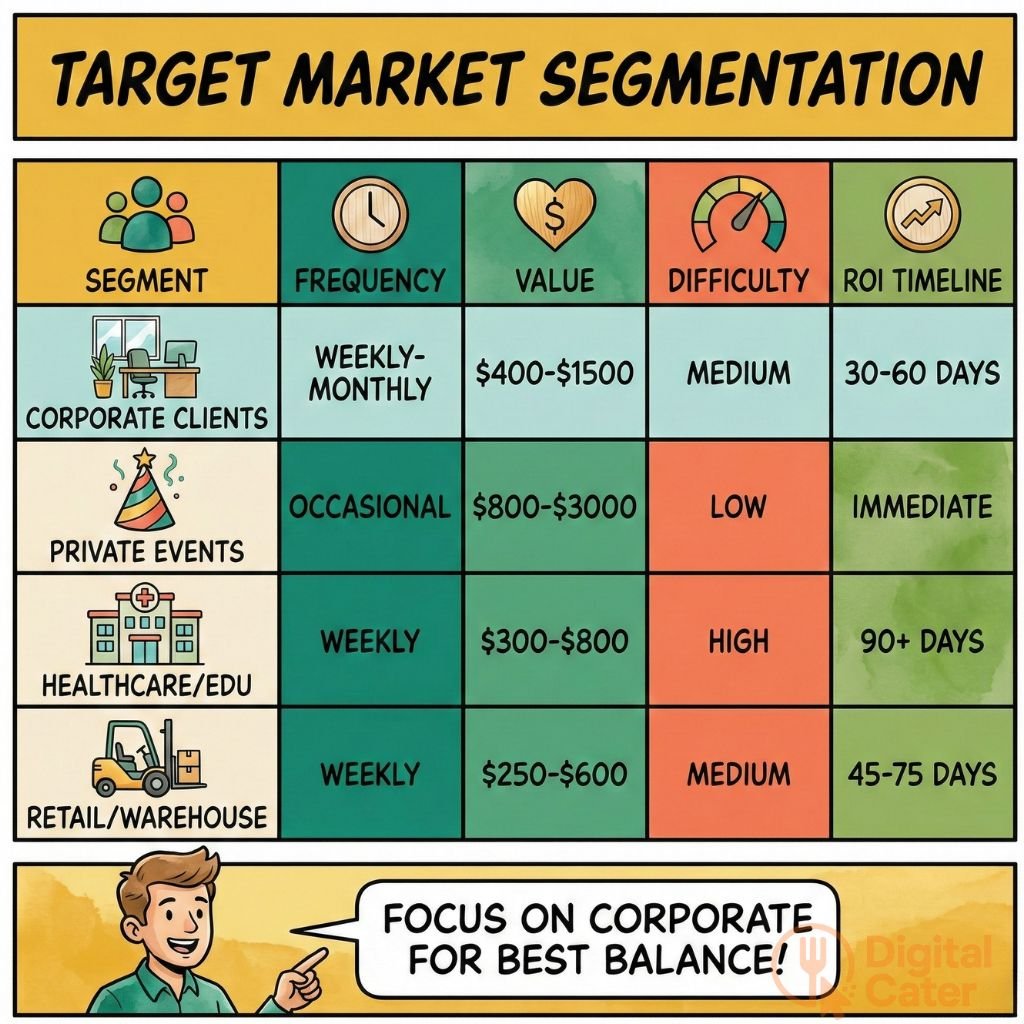
Not all catering clients deliver equal value. Strategic market selection accelerates growth.
Corporate demand has increased 48% since 2020 as businesses use catered meals to attract employees back to offices and retain talent. Monday through Wednesday represent peak ordering days. Morning tea, working lunches, and afternoon events drive volume.
Focus initial efforts on corporate clients within 5 kilometres (3 miles) of your location. This segment offers the best balance of order frequency, value, and acquisition effort.
Foundation – Getting Your Catering Infrastructure Right (Days 1-30)
The first 30 days establish operational foundations. Without proper infrastructure, marketing efforts generate enquiries your systems cannot convert or fulfil.
Building Your Direct Ordering System
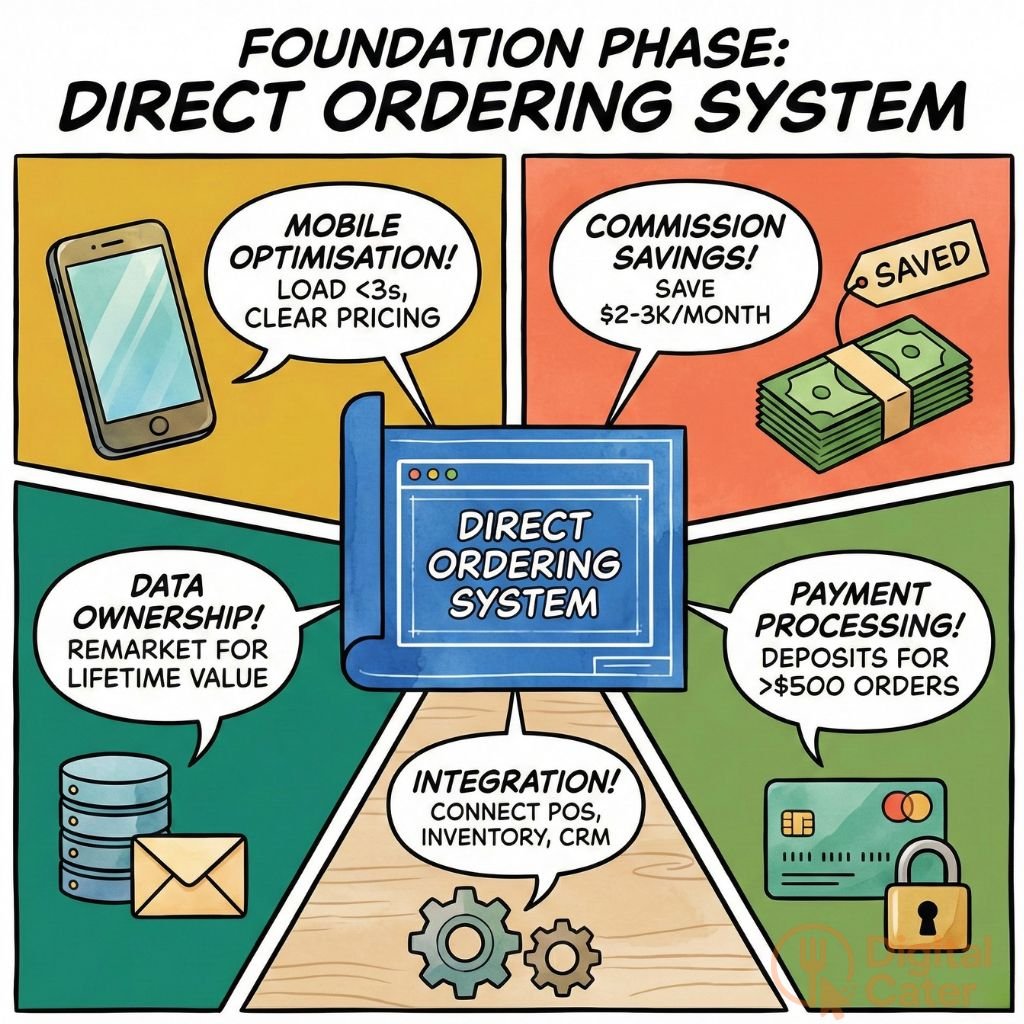
Direct ordering matters for two reasons. Commission savings compound monthly. Data ownership enables remarketing.
Platform selection depends on your scale and technical capacity. Online ordering platforms like Square for Restaurants or specialised catering software offer integrated solutions. Custom web forms work for lower volumes. Hybrid approaches combine existing point-of-sale systems with catering-specific booking pages.
Commission-free direct orders save $2,000-$3,000 monthly for businesses processing $10,000 in catering revenue. Those savings fund marketing, staffing, or margin improvement.
Mobile optimisation is non-negotiable. Over 80% of initial catering research happens on mobile devices. Decision-makers browse options between meetings. If your ordering page loads slowly or displays poorly on mobile, prospects move to competitors.
- Ensure pages load within 3 seconds on mobile networks
- Position the order button above the fold
- Display pricing clearly without required clicks
- Enable quick quote requests for custom orders
Payment processing setup should require deposits for orders above $500. This reduces no-shows and improves cash flow. Accept digital payments including bank transfers, credit cards, and business accounts for corporate clients.
Integrate your ordering system with point-of-sale, inventory management, and customer relationship management tools. Manual data entry creates errors. Automated integration saves hours weekly.
Implementation should complete within the first two weeks.
Engineering a Catering Menu That Sells
Your catering menu requires different construction than your dine-in or delivery menu. Strategic design increases conversion and order values.
Per-person pricing psychology drives purchasing decisions. Corporate buyers think in headcounts, not dish quantities. “$15 per person” converts better than “$150 for 10 servings” even when the mathematics are identical. The per-person frame anchors value against the buyer’s typical meal cost.
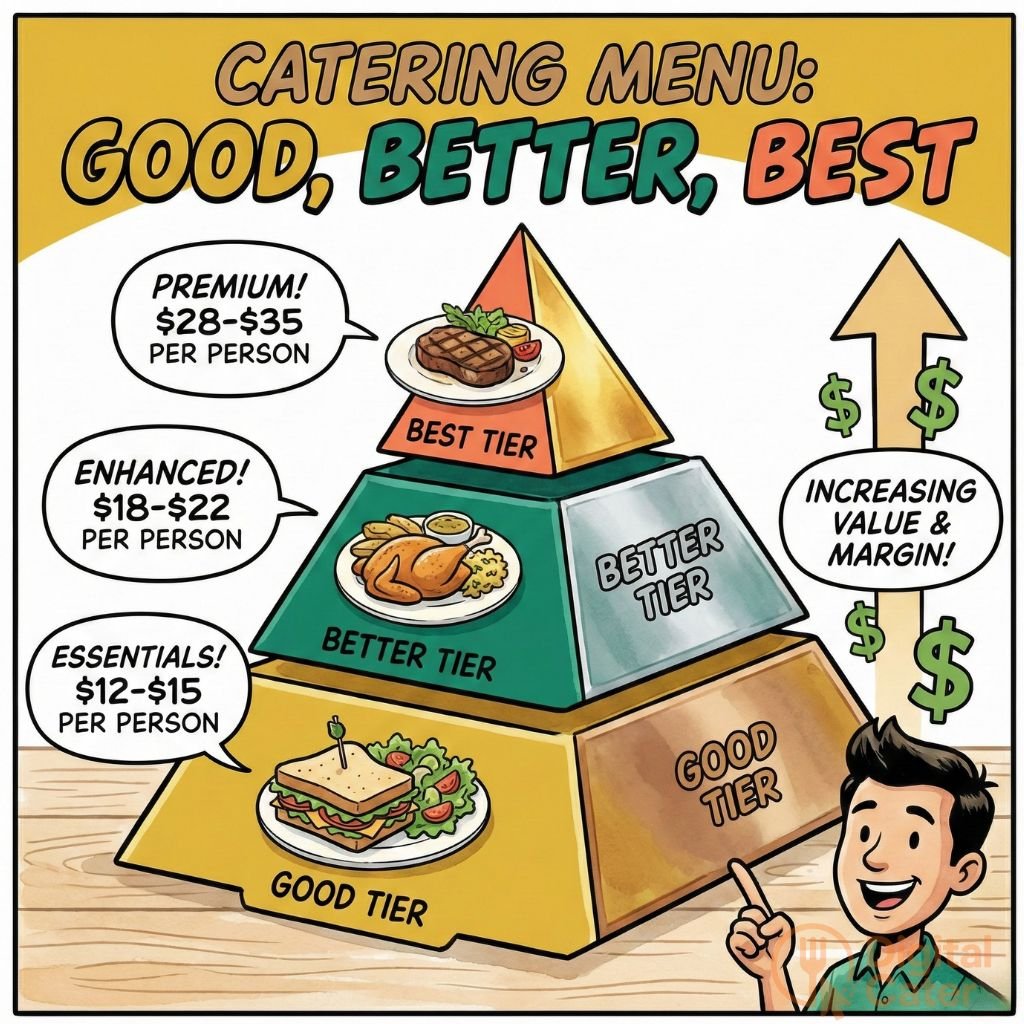
Structure your menu using Good/Better/Best tiers.
- Good Tier ($12-15 per person): Essential options for budget-conscious clients. Sandwich platters, simple salads, basic proteins. Volume comes from this tier.
- Better Tier ($18-22 per person): Enhanced selections with greater variety. Premium proteins, multiple sides, dietary options included. This tier balances margin and accessibility.
- Best Tier ($28-35 per person): Premium offerings for executive meetings and special events. Chef-selected menus, elevated presentation, specialty items. Margin peaks here.
Travel-proof items survive 30-60 minute transport without quality degradation. Avoid items that wilt, separate, or change texture during delivery. Test your menu items by preparing them, boxing them, driving 45 minutes, then evaluating quality.
Dietary inclusivity captures otherwise lost orders. Approximately 22% of Australian adults follow vegetarian, vegan, or plant-based diets. Include clear vegetarian options in every tier. Provide allergen information for common concerns including gluten, dairy, nuts, and shellfish.
Portion calculation charts prevent under-ordering and waste. Standard servings for corporate lunches assume 150 grams protein, 100 grams starch, and 75 grams vegetables per person. Provide these guidelines in your catering materials
Packaging & Presentation Standards
Packaging signals professionalism. It protects food quality. It creates lasting impressions.
Investment-grade packaging includes black-bottom containers with clear lids, sturdy aluminium trays for hot items, and leak-proof boxes for sauced dishes. Budget packaging creates soggy bottoms, collapsed presentations, and temperature loss. The $0.30 difference per container pays for itself in repeat orders.
Branding elements transform deliveries into marketing. Labels with your logo, contact information, and QR codes linking to your catering page turn every order into advertising. Custom stickers on box tops ensure decision-makers see your brand first.
Maintain inventory of packaging supplies sufficient for your largest potential order plus 50%. Running short mid-preparation creates panic and substitution.
Presentation photography serves proposals and marketing. Capture high-resolution images of your catering setups, plated presentations, and packaging. These images close sales before prospects taste your food.
Operational Systems Setup
Systems thinking separates scalable catering operations from chaotic ones.
Point-of-sale configuration requires separate kitchen names or modifiers for catering orders. “Chicken Salad – Catering (serves 10)” communicates differently to kitchen staff than “Chicken Salad x 10.” Portion sizes, container requirements, and preparation timing change for batch production.
Order tracking workflow moves enquiries through defined stages: initial enquiry, quote sent, quote accepted, deposit received, preparation scheduled, quality check complete, delivery dispatched, and follow-up completed. Each stage has an owner and timeline.
Delivery logistics require a decision. In-house delivery offers control and customer interaction but demands vehicles, insurance, and driver management. Third-party delivery reduces complexity but increases cost and reduces reliability. Many businesses use hybrid approaches: in-house for large orders and nearby locations, contracted delivery for smaller orders or distant addresses.
Staff training establishes the Catering Captain role. This person owns catering operations from enquiry to follow-up. They coordinate between kitchen, front-of-house, and delivery teams. Without clear ownership, details fall through gaps.
Quality control checklists run before every delivery. Temperature verification. Item count confirmation. Presentation inspection. Utensil and napkin inclusion. Missing salad dressing destroys the customer experience. A two-minute checklist prevents these failures.
Emergency backup systems prepare for equipment failure, staff illness, or ingredient unavailability. Identify a partner caterer for overflow referrals. Maintain relationships with backup suppliers for critical items.
Visibility – Making Your Catering Impossible to Miss (Days 1-60)
Infrastructure without visibility produces nothing. These tactics ensure potential customers discover your catering services.
In-Store Visibility Optimisation
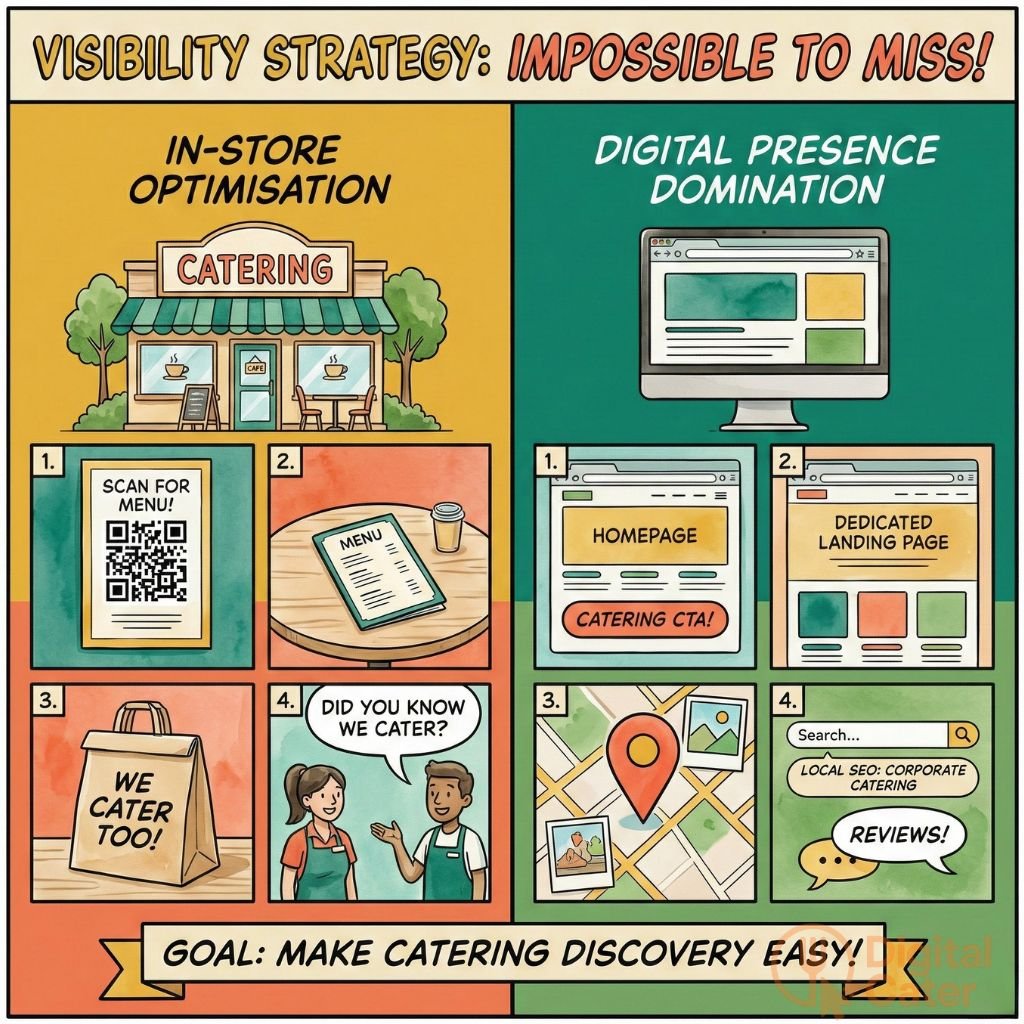
Your existing customer base represents your warmest prospects. Convert dine-in and takeaway customers to catering clients through physical touchpoints.
Poster placement at the register captures attention during wait time. Include a QR code linking directly to your catering page. “We Cater! Corporate lunches, events, and private parties. Scan to see our menu.” Simple messaging works.
Menu distribution puts catering information in customer hands. Place printed catering menus at the point-of-sale, on tables, and in waiting areas. Design differs from your standard menu: larger format, clear pricing, and contact information.
Bag stuffer programmes reach every takeaway customer. A single-page insert in every bag costs cents and reaches hundreds weekly. “Loved your lunch? We cater for offices too.” Include a first-order discount code for tracking.
Staff scripting trains team members to mention catering. “Did you know we cater? We supply corporate lunches to offices in the area.” This 10-second addition to customer interactions generates enquiries weekly.
Physical materials require professional design. A laminated A4 one-pager with your menu, pricing tiers, and contact information costs under $50 for 100 copies.
Total investment for comprehensive in-store visibility runs under $200. Return on investment begins with the first converted customer.
Digital Presence Domination
Digital visibility determines whether corporate buyers find you during online searches.
Your homepage requires an above-the-fold catering call-to-action. “We Cater for Corporate Events” with a prominent button linking to your catering page should appear without scrolling. Most food business websites bury catering information three clicks deep. Decision-makers do not search that thoroughly.
A dedicated landing page architecture presents your catering services comprehensively. This page includes your menu with pricing, minimum order requirements, delivery radius, lead time requirements, dietary accommodations, and an enquiry form. Treat this page as a sales tool, not a brochure.
Service-specific keyword integration helps search engines understand your offerings. Include phrases throughout your website: “corporate catering [your city],” “office lunch catering [your suburb],” “business catering [your area].” These terms match what buyers search.
Google Business Profile optimisation captures local search traffic. Add “Caterer” as a secondary category to your listing. Enable direct ordering links. Upload photos weekly showing your catering presentations. Use Google Posts to announce seasonal packages and promotions.
Local SEO tactics follow a formula: “Corporate catering + [City] + [District/Suburb].” Create content addressing these geographic searches. A page titled “Corporate Catering in Richmond” targets buyers in that specific area.
Schema markup implementation helps search engines display rich results for your business. Local business schema and food establishment schema improve how your listings appear in search results.
Review generation strategy builds social proof. After successful catering orders, request reviews specifically mentioning catering services. “We were so pleased with the corporate lunch catering from [Business Name]” provides keyword-rich testimonials that influence future buyers.
Social Media Strategy for Catering
Social media serves distinct purposes for catering acquisition. Platform selection and content approach determine results.
Platform | Content Type | Posting Frequency | Target Audience | Goal |
Setup photos, behind-scenes, stories | 4-5 times weekly | Event planners, private clients | Visual proof, brand awareness | |
Case studies, corporate testimonials | 2-3 times weekly | Office managers, HR, executives | B2B lead generation | |
Community posts, event promotions | 3-4 times weekly | Local businesses, private events | Local engagement, reviews |
Content batching reduces time investment. Photograph every catering setup before delivery. Capture kitchen preparation for large orders. These images fuel weeks of content from single events.
Social proof deployment converts followers to enquiries. Share client testimonials with permission. Post photos of happy teams enjoying your food. Tag corporate clients who approve visibility. Decision-makers trust peer recommendations over advertising.
Paid advertising parameters focus on geographic and demographic targeting. Target business decision-makers within 10 kilometres (6 miles) of your location. Budget $200-$400 monthly for initial testing. Measure cost per enquiry rather than impressions or clicks.
Proactive Sales – Filling Your Catering Pipeline (Days 31-90)
Visibility attracts inbound enquiries. Proactive sales generate predictable pipeline. This section provides scripts and systems for direct outreach.
The "Sponsored Lunch" Corporate Acquisition System
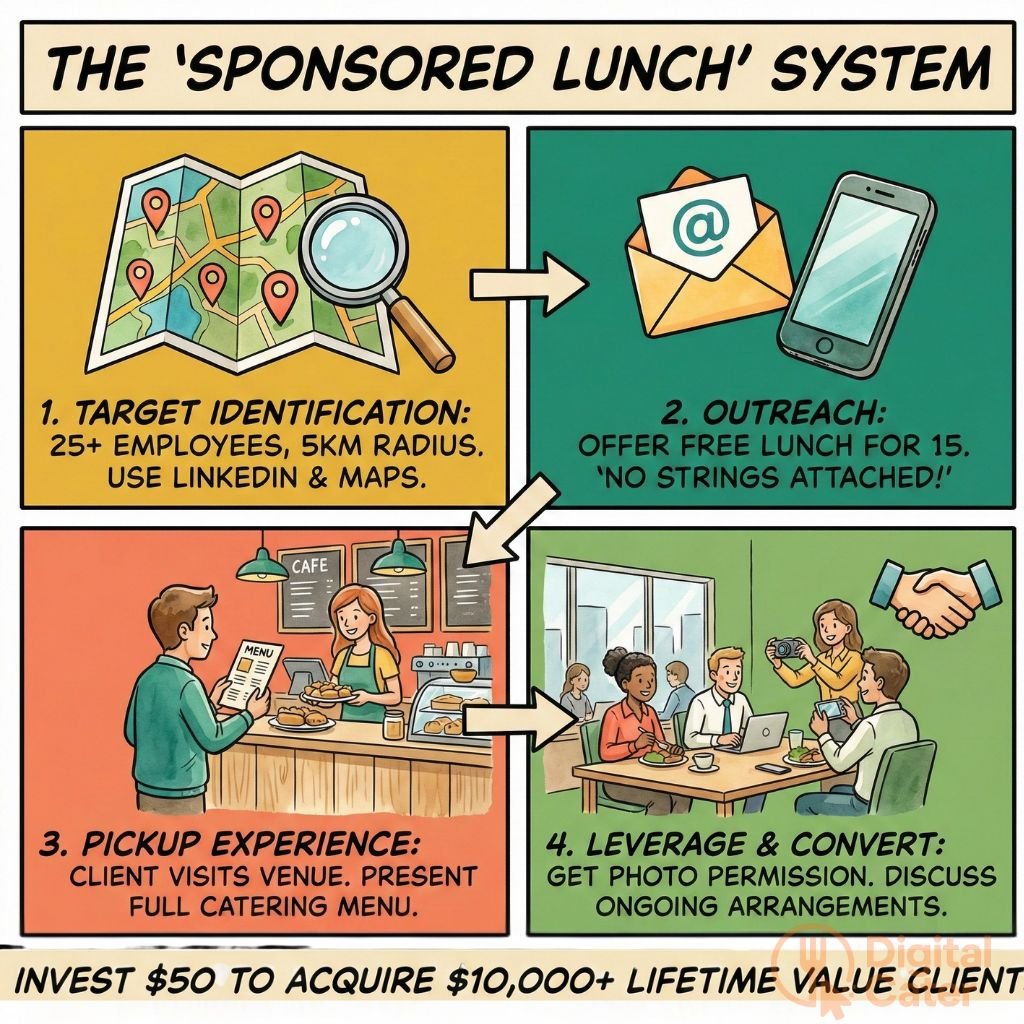
This strategy invests $50 to acquire clients worth $10,000 or more over their lifetime. The mathematics justify the approach.
Target Identification: Research companies with 25 or more employees within 5 kilometres (3 miles) of your location. Office parks, business centres, and commercial precincts concentrate prospects. LinkedIn company pages reveal employee counts. Google Maps identifies locations.
Outreach Script (Email):
Subject: Free Team Lunch for [Company Name]?
Hi [Name],
I own [Your Business] on [Street Name], about [X] minutes from your office. We supply corporate lunches to businesses in [Area] and would love to introduce ourselves to your team.
I’d like to offer a complimentary lunch for up to 15 people – no strings attached. If your team enjoys it, we can discuss ongoing arrangements. If not, you’ve fed your team for free.
Would next [Tuesday/Wednesday] work? Happy to accommodate dietary requirements.
[Your Name] [Phone Number]
Phone Follow-up Script: Call 48 hours after email if no response. “Hi, this is [Name] from [Business]. I sent an email about a complimentary team lunch – wanted to check if it landed in the right inbox?”
Logistics Structure: Require pickup rather than delivery for sponsored lunches. This reduces your cost and brings decision-makers into your venue. During pickup, they experience your operation firsthand.
Immediate Conversion: When the contact arrives for pickup, have a catering menu ready. “Here’s our full catering menu. The lunch today is our ‘Better’ tier – we also offer lighter options and premium selections. What does your typical team lunch look like?”
Social Media Leverage: Request permission to photograph the team enjoying lunch. This content fuels future marketing while creating reciprocity with the new contact.
Send 20 outreach emails weekly. Expect 3-5 responses. Convert 1-2 to sponsored lunches. Convert 50% of those to paying clients within 30 days.
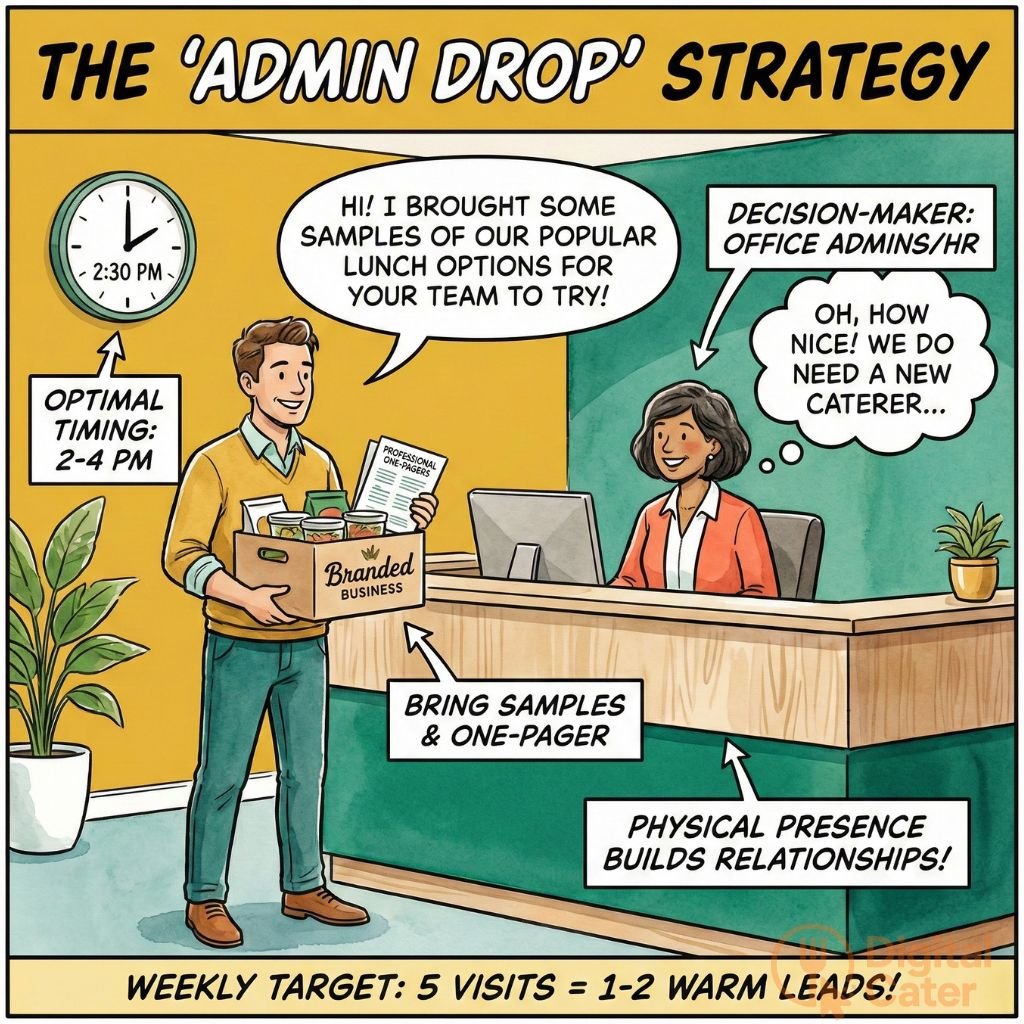
Manager Field Visits ("Admin Drop" Strategy)
Physical presence builds relationships that email cannot replicate.
Optimal Timing: Visit between 2-4 PM when office activity slows. Morning visits interrupt productivity. Late afternoon catches decision-makers before departure.
Decision-Maker Identification: Office administrators, HR coordinators, and executive assistants control catering budgets. Ask reception: “Who handles catering arrangements for your team meetings?”
Physical Materials: Bring a professional one-pager with menu highlights, QR code to your catering page, and your direct contact information. Laminated A5 cards survive desk clutter better than paper flyers.
Sample Strategy: Taste samples convert better than discount coupons. Bring 2-3 portions of your signature items in professional packaging. “I brought a few items for you and your team to try – our most popular corporate lunch options.”
Follow-up Protocol: Enter contact details into your CRM within 24 hours. Send a brief email thanking them for their time and reattaching the digital menu.
Weekly Volume Target: Complete 5 field visits per week. This generates 1-2 warm leads weekly, compounding over 90 days to a substantial pipeline.
Strategic Partnership Development
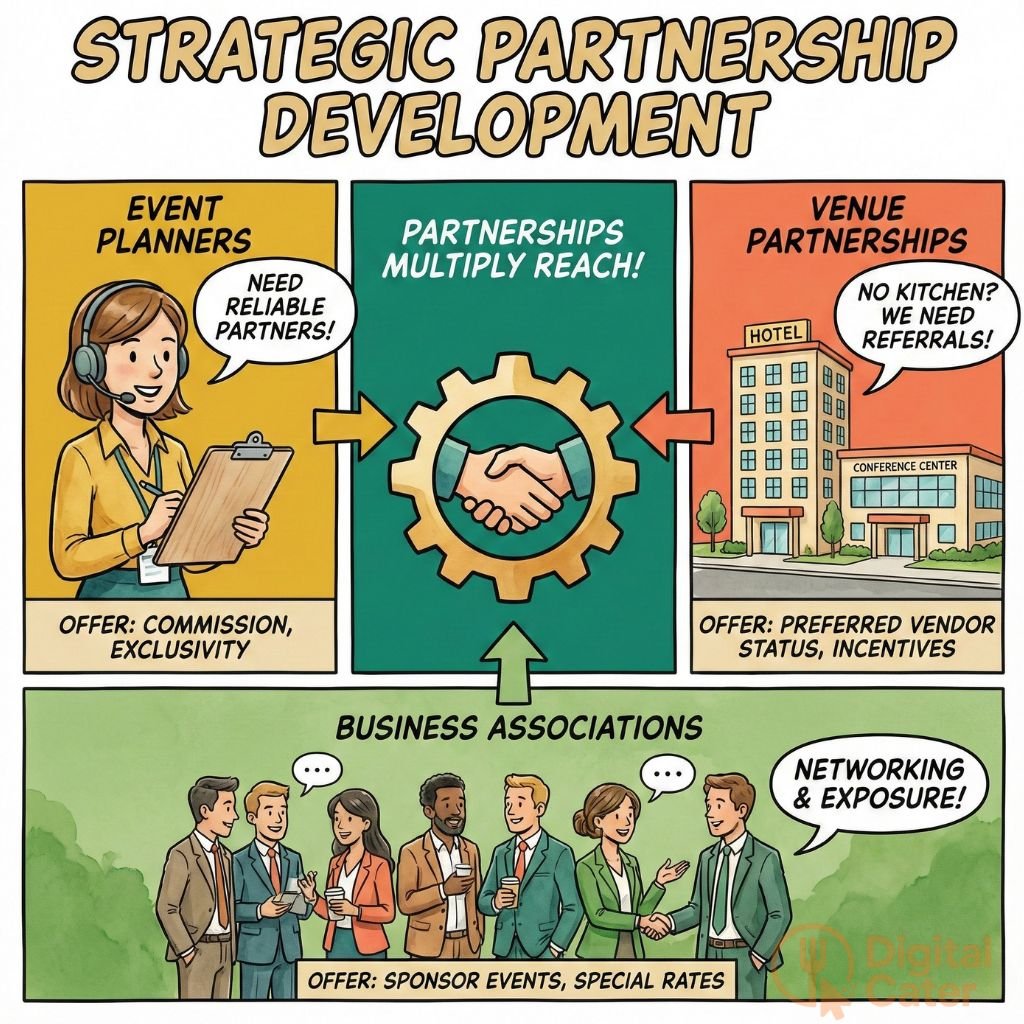
Partnerships multiply your reach without proportional effort.
Event Planners: These professionals coordinate multiple events monthly and need reliable catering partners. Offer 10-15% commission on referred business. Provide dedicated contact and priority booking. Consider exclusivity arrangements for high-volume planners.
Venue Partnerships: Hotels, conference centres, and event spaces without in-house kitchens need catering referrals. Position yourself as their preferred vendor. Offer venue staff a referral incentive. Provide marketing materials they can share with clients.
Business Associations: Chamber of Commerce meetings, BNI groups, and industry associations gather your target audience. Attend networking events. Offer to cater association functions at reduced rates for exposure. Sponsor events for visibility.
Customer Referral Programmes: Existing clients provide the warmest introductions. Offer $50 credit toward their next order for each referred client who places an order. Track referral sources to identify your best advocates.
Conversion – Turning Marketplace Orders Into Direct Customers
Every marketplace order represents an acquisition opportunity. These tactics convert third-party customers to direct relationships.
The Direct Order Conversion Playbook
Marketplace customers already trust your food. They simply need a reason to order directly.
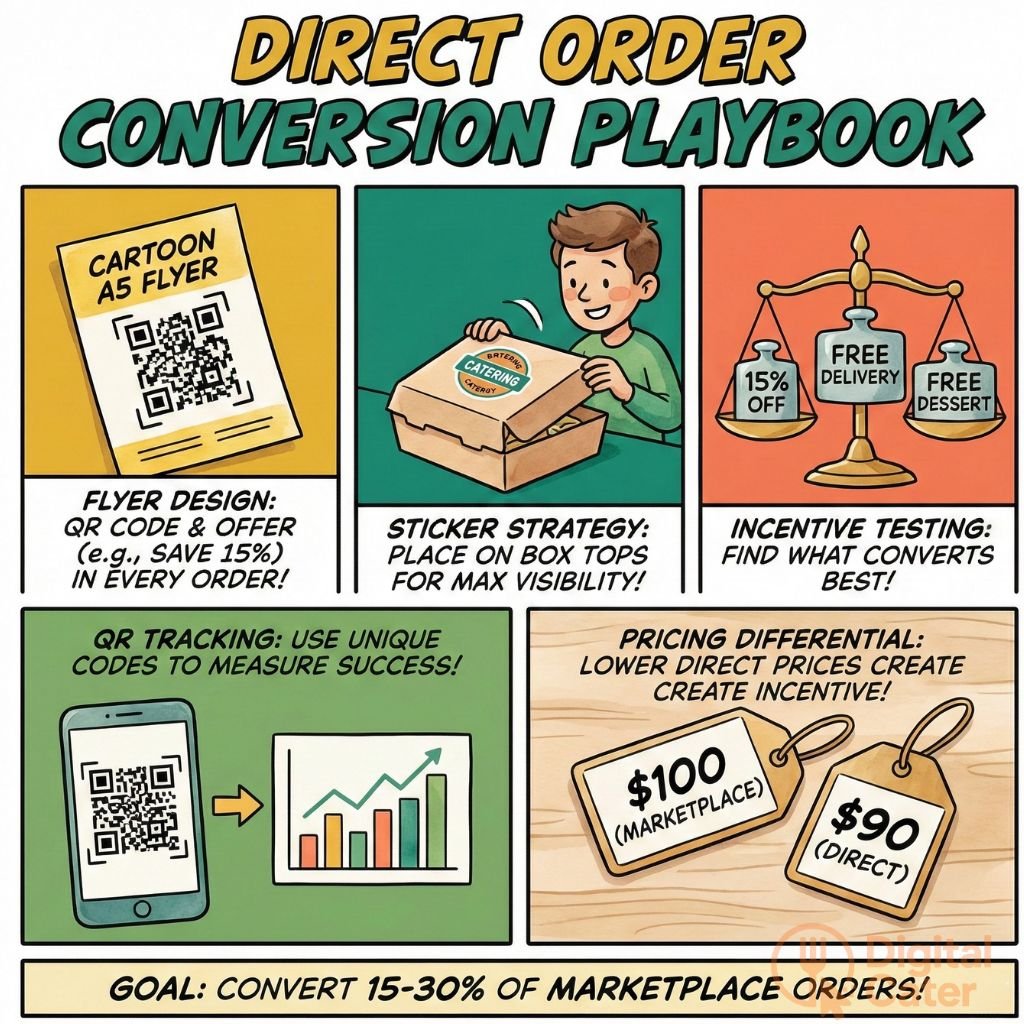
Flyer Design Specifications: Create a professional A5 insert for every marketplace order. Include your logo, direct ordering URL, QR code, and a compelling offer. “Order direct and save 15% on your next catering order.”
Sticker Placement Strategy: Place branded stickers on box tops where organisers see them first. The person unpacking the order often differs from the person who placed it. Your sticker introduces your brand to additional decision-makers.
Incentive Structuring: Test different offers to identify what converts. A 10-15% discount appeals to budget-conscious buyers. Free delivery removes friction. A complimentary dessert platter adds perceived value without significant cost. Track redemption rates to optimise.
QR Code Tracking: Use unique QR codes or discount codes for marketplace inserts. This data reveals conversion rates and justifies continued investment.
Pricing Differential Strategy: Where marketplace terms permit, price direct orders 5-10% lower than marketplace listings. This creates rational incentive for customers to switch channels.
Expected conversion rate ranges from 15-30% within 90 days. A business processing 40 marketplace catering orders monthly can expect 6-12 direct conversions, representing $3,000-$6,000 in commission savings annually.
CRM Management & Follow-up
Customer relationship management transforms one-time orders into recurring revenue.
Data Architecture: Capture essential fields for every catering customer: company name, decision-maker name and contact, order history with dates and values, dietary requirements, and delivery preferences. This information enables personalised follow-up.
Segmentation Strategy: Separate corporate clients from private event customers. Their buying cycles, communication preferences, and reorder patterns differ. Corporate clients respond to Monday morning emails. Private clients engage on weekends.
Automated Sequences: Build email sequences that nurture without manual effort.
- 24-hour post-delivery thank you with feedback request
- 7-day check-in asking about team response
- 30-day reorder incentive with modest discount
- Quarterly touchpoint highlighting seasonal offerings
Email Marketing Timing: Send corporate communications Monday morning between 8-10 AM. Decision-makers plan their week during this window. Tuesday and Wednesday emails perform adequately. Thursday-Friday emails underperform as recipients focus on week completion.
Execution Excellence – Operational Discipline
Systems generate orders. Execution retains clients. These frameworks ensure consistent delivery.
The Reliability Framework
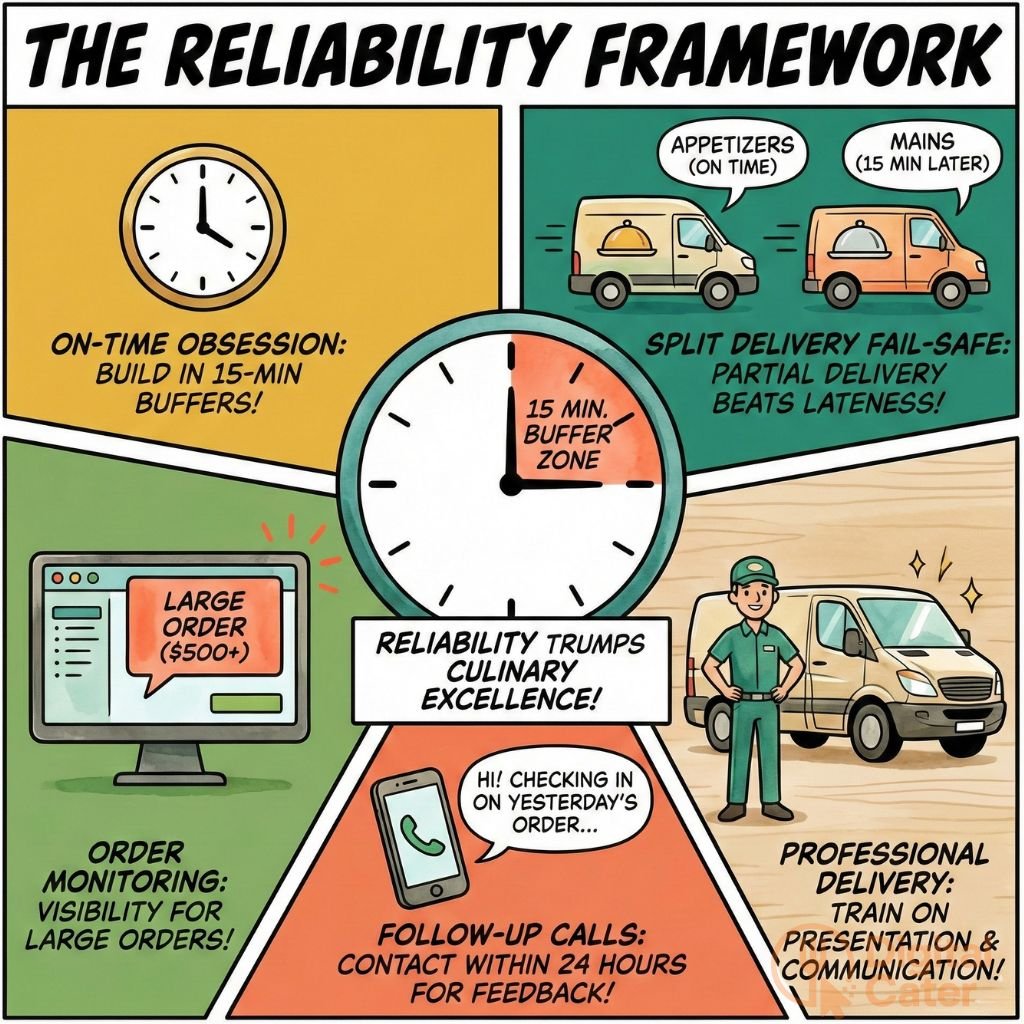
Reliability trumps culinary excellence in catering. A spectacular meal arriving 30 minutes late destroys the customer relationship.
On-Time Obsession: Build 15-minute buffers into every delivery schedule. Traffic, parking, and building access create unpredictable delays. Early arrival allows setup time. Late arrival creates client stress.
Split Delivery Fail-Safe: When circumstances threaten delivery time, send partial orders on schedule. Deliver appetisers and salads on time while main courses follow 15 minutes later. Communicate proactively. “Your first course is arriving now. Mains will follow in 15 minutes due to [reason].” Partial delivery beats complete lateness.
Order Monitoring: Create visibility systems for orders exceeding $500. Kitchen staff, delivery team, and management should see these orders on shared dashboards. Large orders warrant additional attention.
Professional Delivery: Train drivers on presentation standards. Clean vehicles. Professional attire. Courteous communication. The delivery person represents your brand in the client’s space.
Follow-up Calls: Contact customers within 24 hours for orders exceeding $300. “Hi, this is [Name] from [Business]. I wanted to check that everything met your expectations with yesterday’s delivery.” This call identifies issues before they become complaints and demonstrates commitment to service.
The "Never Say No" Policy
Flexibility builds reputation. Rigid policies lose clients to accommodating competitors.
Over-Capacity Requests: “We’re fully committed on Thursday, but we can accommodate you Wednesday or Friday. Would either work?” Offer alternatives rather than flat refusals.
Unavailable Menu Items: “We’re out of the salmon today, but our barramundi preparation is similar and clients love it. I can substitute at no extra charge.” Present solutions alongside problems.
Short Notice Requests: “We can handle that with 90 minutes notice. Let me check kitchen capacity and confirm within 10 minutes.” Responsiveness wins orders competitors reject.
Beyond Delivery Radius: “That location is outside our standard area, but I have a colleague who operates there. Let me connect you.” Referrals to partner caterers build goodwill and often generate reciprocal referrals.
The perception matters as much as the outcome. Customers remember businesses that tried to help.
Upselling & Revenue Optimisation
Strategic upselling increases average order value by 30% without additional customer acquisition.
Logical Add-ons: Suggest items that complement the base order. “Would you like coffee service for the afternoon portion of your meeting? We can include that for $4 per person.” Beverages, dessert platters, and morning tea additions increase value naturally.
Premium Upgrades: Offer presentation enhancements. “For $3 per person, we can provide china service instead of disposable containers. It creates a more polished impression for client meetings.” Frame upgrades around customer benefit.
Subscription Programmes: Propose weekly arrangements for regular clients. “If you’re doing team lunches every Tuesday, we can lock in pricing and priority scheduling. Most clients save 10% on recurring orders.” Recurring revenue stabilises cash flow.
Minimum Thresholds: Structure free delivery above certain order values. “Delivery is complimentary for orders over $200.” This encourages customers to increase orders rather than pay delivery fees.
A $300 base order becomes $390 with strategic upselling. Across 50 monthly orders, this represents $4,500 in additional revenue.
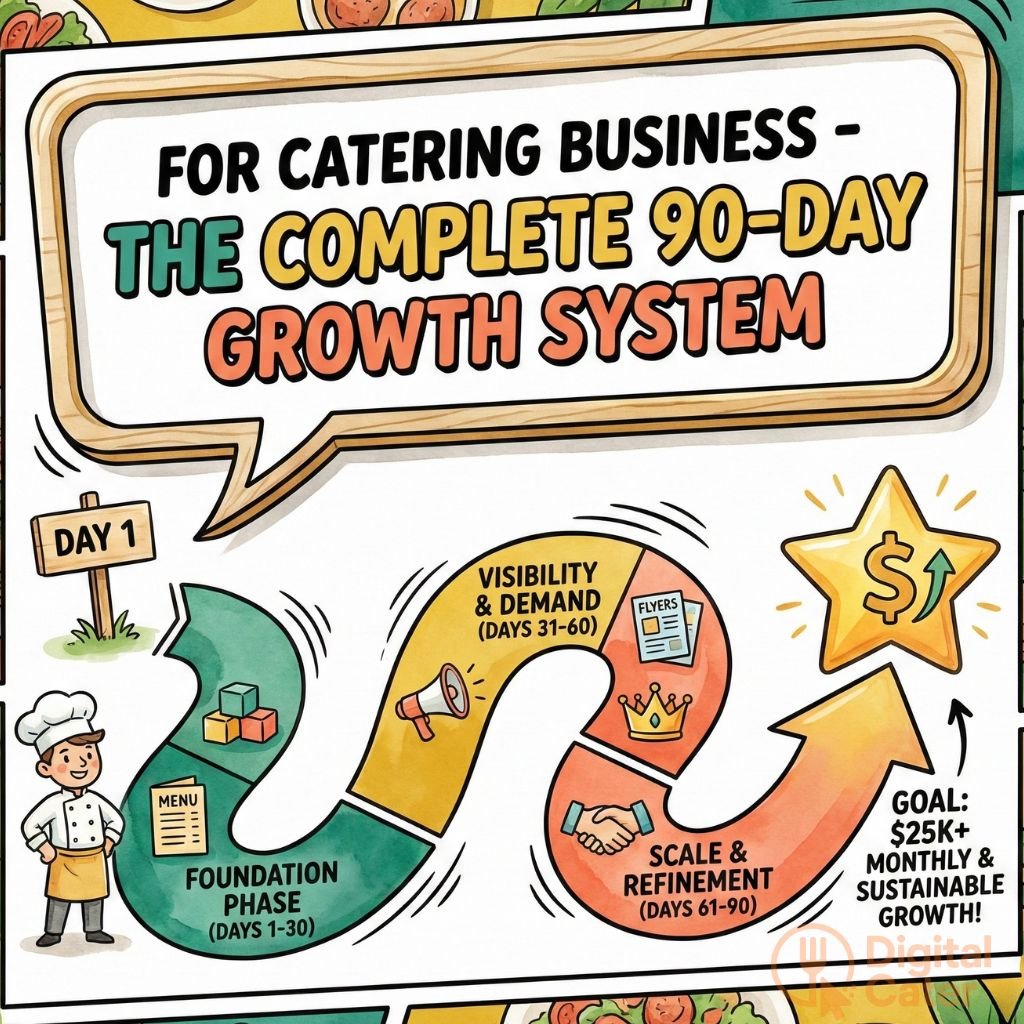
30/60/90-Day Implementation Roadmap
This timeline provides week-by-week guidance for systematic implementation.
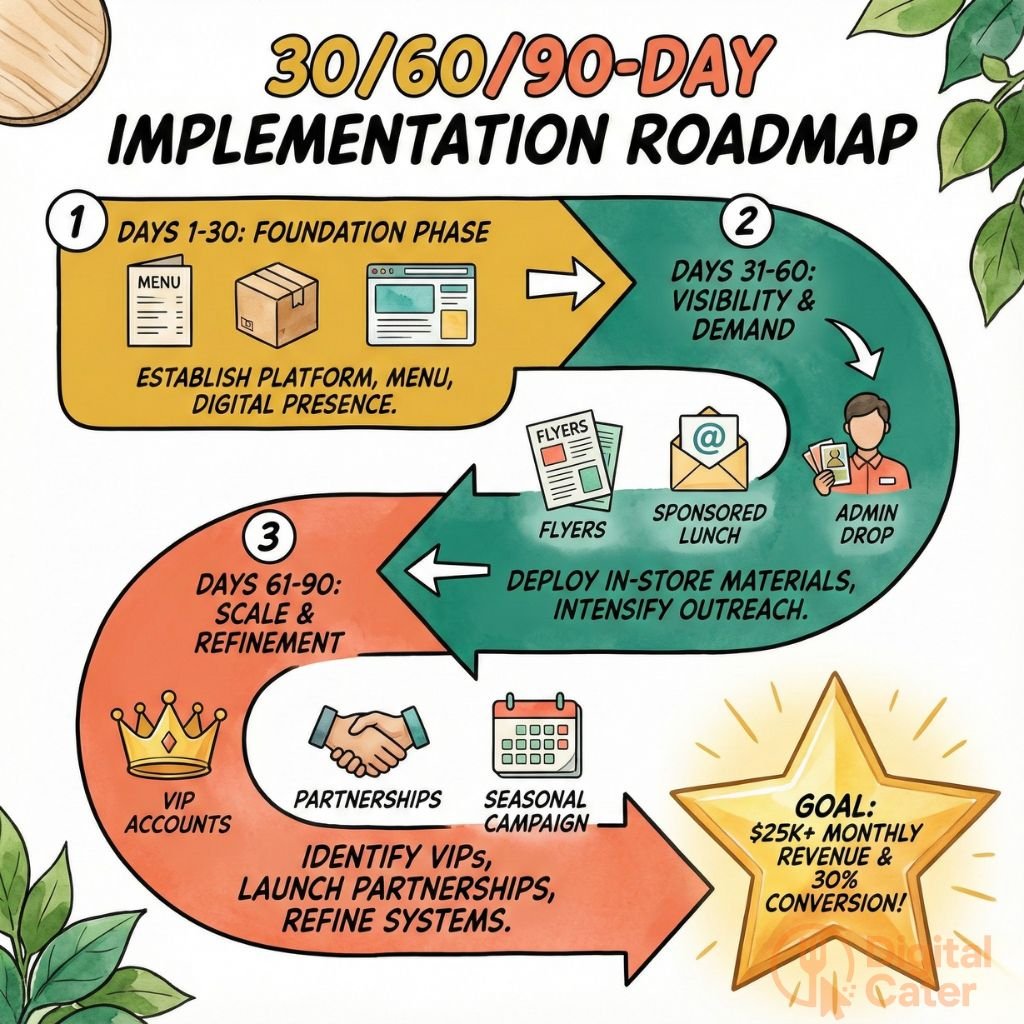
Days 1-30: Foundation Phase
Week 1: Establish direct ordering platform. Begin catering menu engineering with tiered pricing.
Week 2: Source and order packaging materials. Develop staff training materials and conduct initial training sessions.
Week 3: Optimise digital presence. Update website with catering landing page. Configure Google Business Profile with catering category and images.
Week 4: Launch first proactive outreach campaign. Send initial batch of sponsored lunch emails.
Deliverables by Day 30: Operational catering menu with three tiers, functional direct ordering system, trained staff with defined roles, and digital presence optimised for catering searches.
Days 31-60: Visibility & Demand Generation
Week 5-6: Deploy in-store visibility materials. Implement bag stuffer programme. Increase social media posting frequency with catering-focused content.
Week 7-8: Intensify sponsored lunch programme to 20 emails weekly. Conduct 5 field visits weekly using the Admin Drop strategy.
Deliverables by Day 60: 5-10 qualified corporate prospects in pipeline, 2-3 converted paying accounts, complete marketing material deployment across physical and digital channels.
Days 61-90: Scale & Refinement
Week 9-10: Identify VIP accounts from first 60 days and develop retention strategies. Initiate partnership conversations with event planners and venues.
Week 11-12: Launch seasonal campaign aligned with upcoming holidays or events. Conduct performance review analysing conversion rates, average order values, and customer feedback. Refine menu based on sales data and client input.
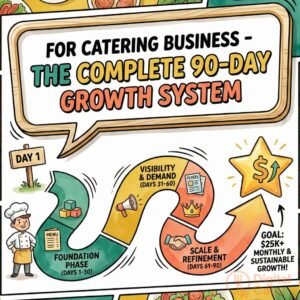
Goal Statement: By Day 90, migrate 30% of marketplace orders to direct channels. Build toward $25,000 monthly in direct catering revenue. Establish systems for sustainable growth beyond the initial implementation period.
Frequently Asked Questions
- How much should I charge for catering compared to my regular menu? Price catering items 15-25% higher than equivalent dine-in portions. The premium covers packaging, transport logistics, and batch preparation complexity. Corporate clients expect professional pricing.
- What minimum order value should I set? Set minimums between $150-$200 for delivery orders. This ensures profitability after delivery costs. Offer pickup options for smaller orders without minimums.
- How far should my delivery radius extend? Start with 8-10 kilometres (5-6 miles) from your location. Expand gradually as you build delivery capacity. Charge additional fees for distant deliveries rather than refusing them.
- How much lead time should I require for catering orders? Request 48-72 hours for standard orders. Accept 24-hour requests when capacity permits. Large orders exceeding $1,000 should require one week notice.
- What happens if a client cancels last minute? Require non-refundable deposits of 30-50% for orders exceeding $500. Include cancellation terms in your order confirmation. Offer credit toward future orders rather than refunds for goodwill.
- Should I offer tastings before large orders? Offer tastings for accounts with annual potential exceeding $5,000. Charge a nominal fee ($50-$100) refundable against the first order. This filters serious prospects from time-wasters.
- How do I handle dietary requirements I cannot accommodate? Partner with specialist caterers for requirements outside your capability. Refer business rather than attempting unfamiliar preparations. The referral builds relationships and avoids quality issues.
- What insurance do I need for catering operations? Maintain public liability insurance covering off-premises service. Verify coverage includes food service at client locations. Consult your insurance broker for appropriate policy limits.
- How do I compete with established catering companies? Compete on responsiveness, personalisation, and local presence. Large caterers cannot match the flexibility and attention small operators provide. Position these advantages prominently.
- When should I hire dedicated catering staff? Consider dedicated roles when catering exceeds 25% of total revenue or 20 orders monthly. Start with a part-time Catering Captain role combining coordination and sales responsibilities.
Conclusion
Catering growth compounds. The sponsored lunch you provide this week generates the corporate account that orders monthly for years. The systems you build today handle volume you cannot yet imagine.
Three elements drive success. Visibility ensures potential customers discover your catering services through physical touchpoints, digital presence, and proactive outreach. Systems enable your operation to handle increasing volume without quality degradation. Sales strategies convert prospects to customers and marketplace orders to direct relationships.
The mindset shift matters most. Treat catering as a profit centre deserving dedicated resources, not a side activity handled when convenient. The $50 sponsored lunch investment generates $10,000 in lifetime value. The $200 field visit programme builds a corporate client base worth six figures annually.
Choose three actions from this guide to implement this week. Configure your direct ordering system. Print bag stuffers for your takeaway orders. Send your first five sponsored lunch emails. Progress compounds through consistent action.
Your catering revenue potential awaits systematic capture. The 90-day framework provides the path. Your execution determines the destination.