Seventy-three per cent of diners discover restaurants online before deciding where to eat. Your food might be outstanding, but great cooking alone won’t fill tables in 2025. Today’s restaurant success demands a digital presence that works as hard as your kitchen team.
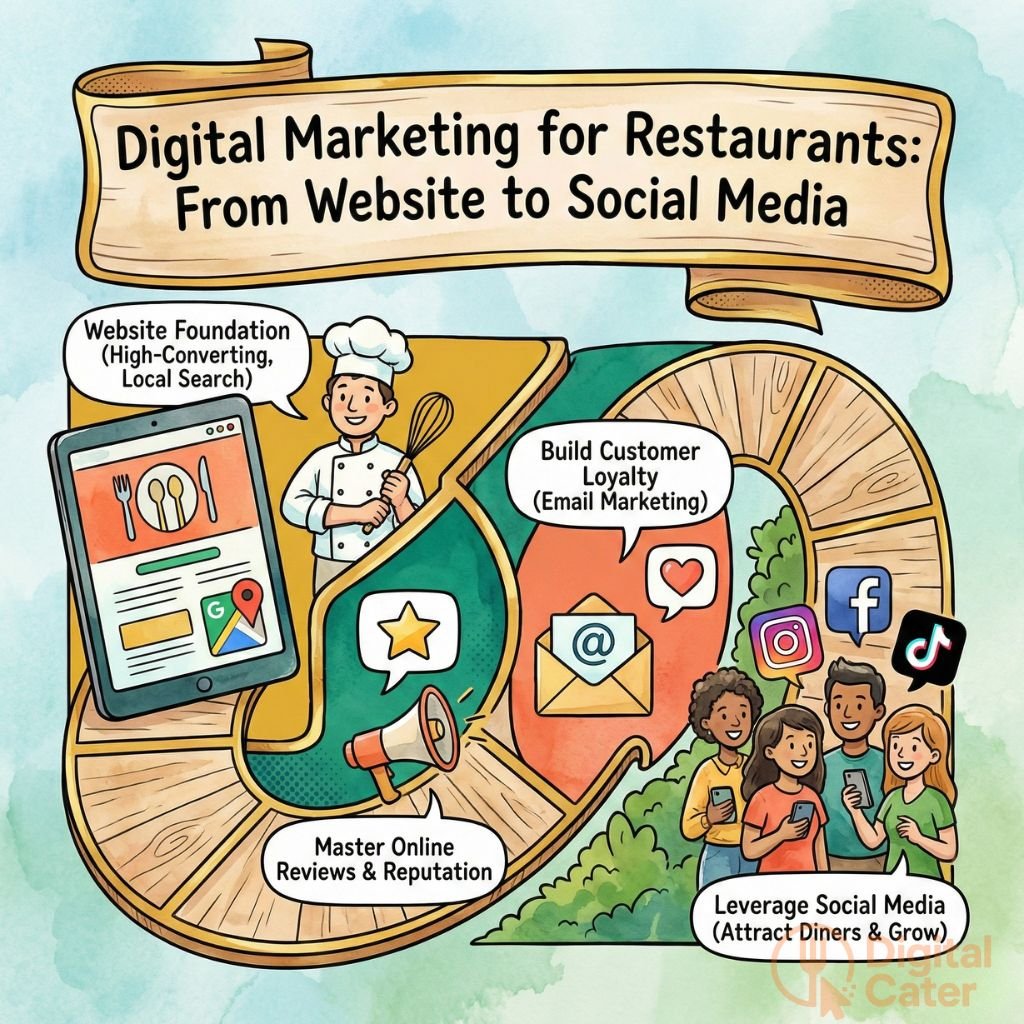
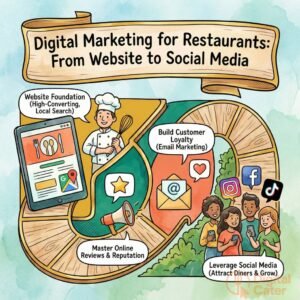
This guide delivers seven proven strategies that drive real results for restaurants. You’ll learn how to build a website that converts visitors into customers, dominate local search, turn reviews into revenue, and leverage social media strategically. Each section includes practical steps, benchmarks, and timelines you can implement immediately.
We’ve tested these methods across dozens of food businesses over the past decade. They work for small cafés and multi-location operations alike. The key? Start with fundamentals, measure results, and expand what performs.
Setting Your Digital Marketing Foundation
Before diving into tactics, establish your strategic framework. Restaurants that skip this step waste time and money on activities that don’t align with their goals. Fifty words of planning prevents months of scattered effort.
Define Your Goals
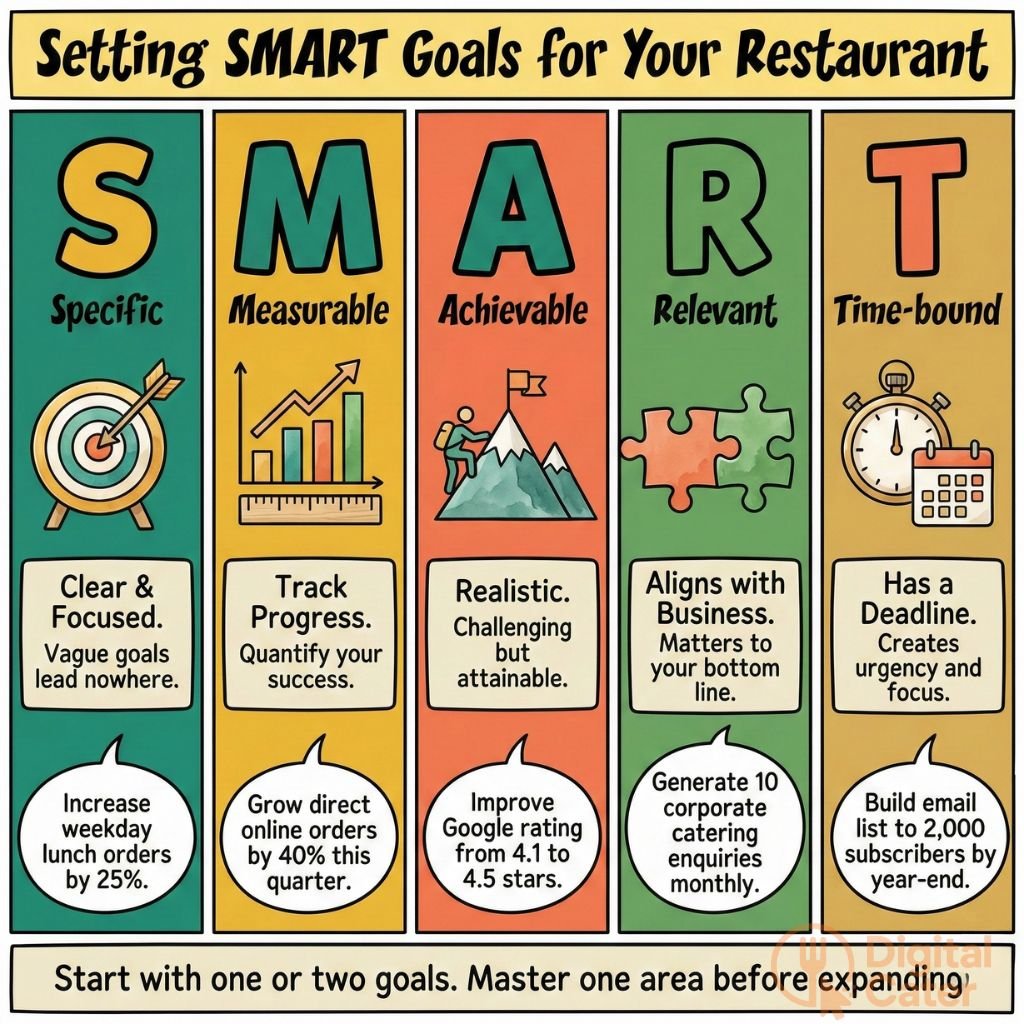
Apply the SMART framework: specific, measurable, achievable, relevant, and time-bound. Vague aims like “get more customers” lead nowhere. Clear targets create focus.
Restaurant-specific goals that work:
- Increase weekday lunch orders by 25% in 90 days
- Grow direct online orders by 40% this quarter
- Build email list to 2,000 subscribers by year-end
- Improve Google rating from 4.1 to 4.5 stars
- Generate 10 corporate catering enquiries monthly
Start with one or two goals, not everything. Master one area before expanding.
Know Your Audience
Who walks through your door? Understanding your ideal customer shapes every marketing decision you make.
Answer these questions: What age bracket, income level, and preferences define your core diners? A fine-dining establishment targeting 35-55 affluent professionals requires different messaging than a casual taco shop pursuing 21-35 value-seekers. This knowledge determines which platforms you choose and how you communicate.
Create one or two customer personas. Document their dining habits, pain points, and preferences. Reference these profiles when creating content.
Establish Your Brand Voice
Your brand voice represents your restaurant’s personality across all communications. Consistency matters because it builds recognition and trust.
Consider these contrasting examples:
- Upscale French restaurant: Sophisticated, refined language emphasising culinary artistry and elegant experiences
- Family pizzeria: Warm, welcoming tone focusing on tradition, comfort, and bringing people together
- Craft brewery: Bold, irreverent voice celebrating innovation and adventure in flavour
Use this same voice everywhere: website copy, social media posts, email campaigns, and review responses.
Build a High-Converting Restaurant Website
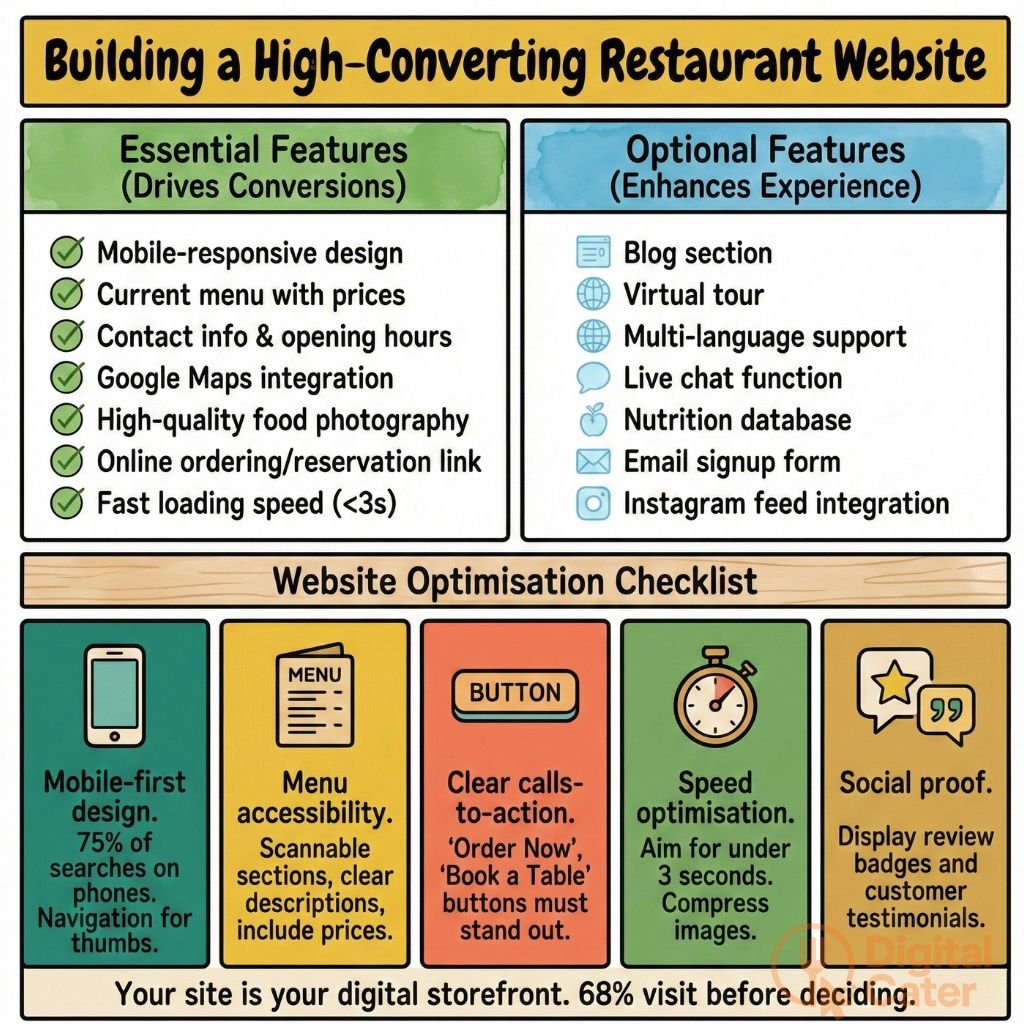
Sixty-eight per cent of potential customers visit your website before deciding. Your site serves as your digital storefront. It must load fast, look professional, and make ordering simple.
Distinguish between essential features that directly impact conversions and optional elements that add polish.
Essential vs. Optional Features
The essential column drives bookings and orders. The optional column enhances user experience but won’t make or break your business.
Website Optimisation Checklist
- Mobile-first design: Seventy-five per cent of restaurant searches happen on phones. Test your site on multiple devices. Navigation must work with thumbs, not mouse clicks.
- Menu accessibility: Place your menu in top navigation where visitors expect it. Make it scannable with clear sections and descriptions. Include prices to filter out price-sensitive visitors early.
- Clear calls-to-action: Every page needs obvious next steps. “Order Now,” “Book a Table,” and “View Menu” buttons should stand out visually.
- Speed optimisation: Compress images without losing quality. Aim for page loads under three seconds. Slow sites lose 40% of visitors.
- SEO basics: Include location keywords in page titles and descriptions. “Italian Restaurant in Melbourne CBD” performs better than “Great Italian Food.”
- Social proof: Display review badges and customer testimonials prominently. Third-party validation builds trust faster than your own claims.
- Up-to-date information: Wrong opening hours frustrate customers and waste their time. Audit your site monthly for accuracy.
Dominate Local Search with Google Business Profile
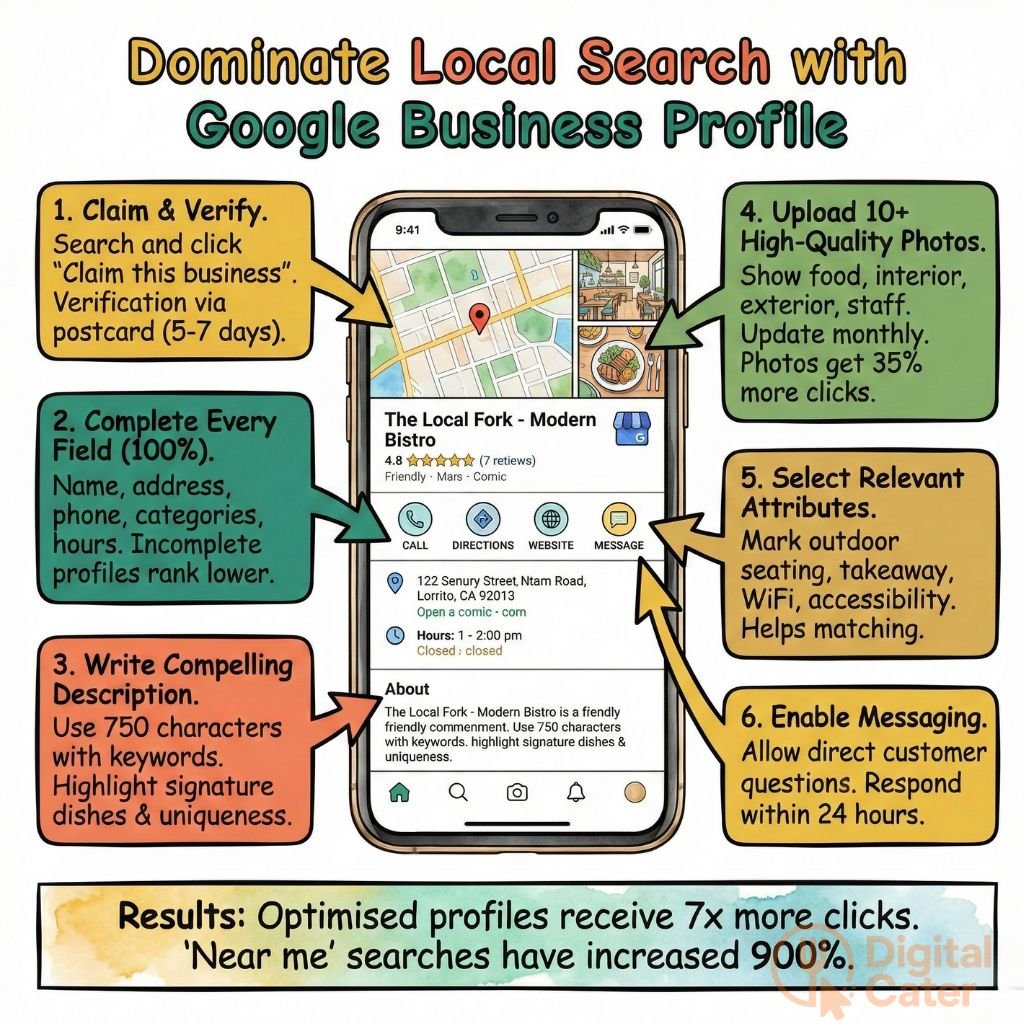
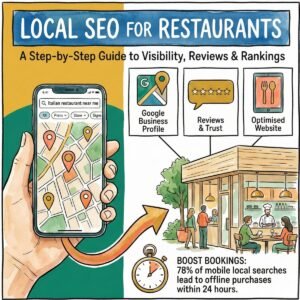
“Near me” searches increased 900% in recent years. Your Google Business Profile represents the single most powerful tool for local discovery. It’s free, takes 30 minutes to optimise, and appears above organic results in the Local Pack.
Optimisation Steps
- Claim and verify your listing: Search for your restaurant on Google. Click “Claim this business” if unclaimed. Verification takes 5-7 days via postcard.
- Complete every field at 100%: Fill in name, address, phone number, categories, and opening hours. Google favours complete profiles in rankings.
- Write a compelling description: Use your 750-character limit wisely. Include keywords naturally whilst highlighting signature dishes and unique aspects. “Award-winning Thai restaurant in Sydney serving authentic Pad Thai, Green Curry, and Tom Yum since 2015. Vegan and gluten-free options available.”
- Upload 10+ high-quality photos: Show exterior, interior, food, drinks, and staff. Update monthly with fresh images. Photos receive 35% more clicks than listings without them.
- Select relevant attributes: Mark features like outdoor seating, takeaway, delivery, WiFi, wheelchair accessibility. These help Google match you to specific searches.
- Enable messaging: Allow customers to text questions directly. Respond within 24 hours to maintain eligibility.
Results and Impact
Optimised profiles receive seven times more clicks than incomplete ones. Your profile appears in Google Maps, Search, and voice assistant results. It forms the foundation of all local SEO efforts and serves as your primary review collection platform.
Master Online Reviews & Reputation
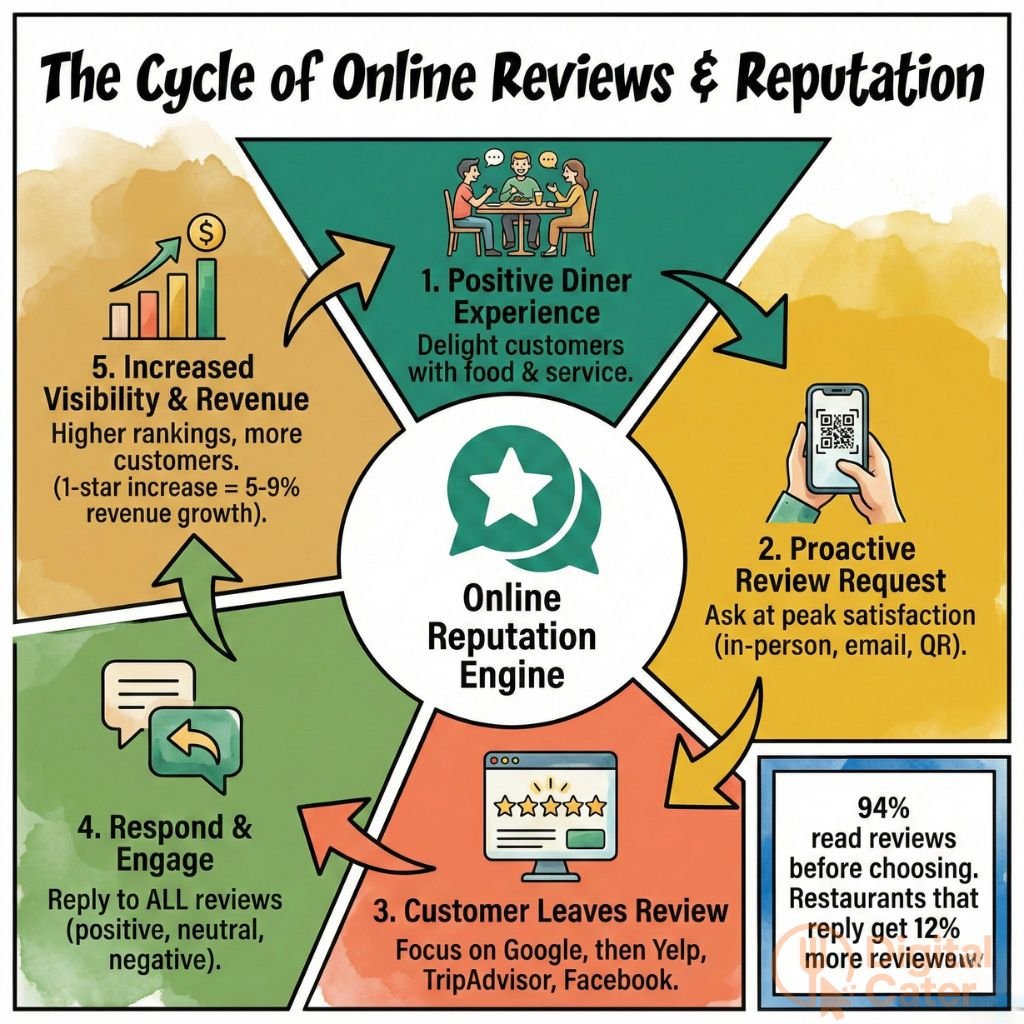
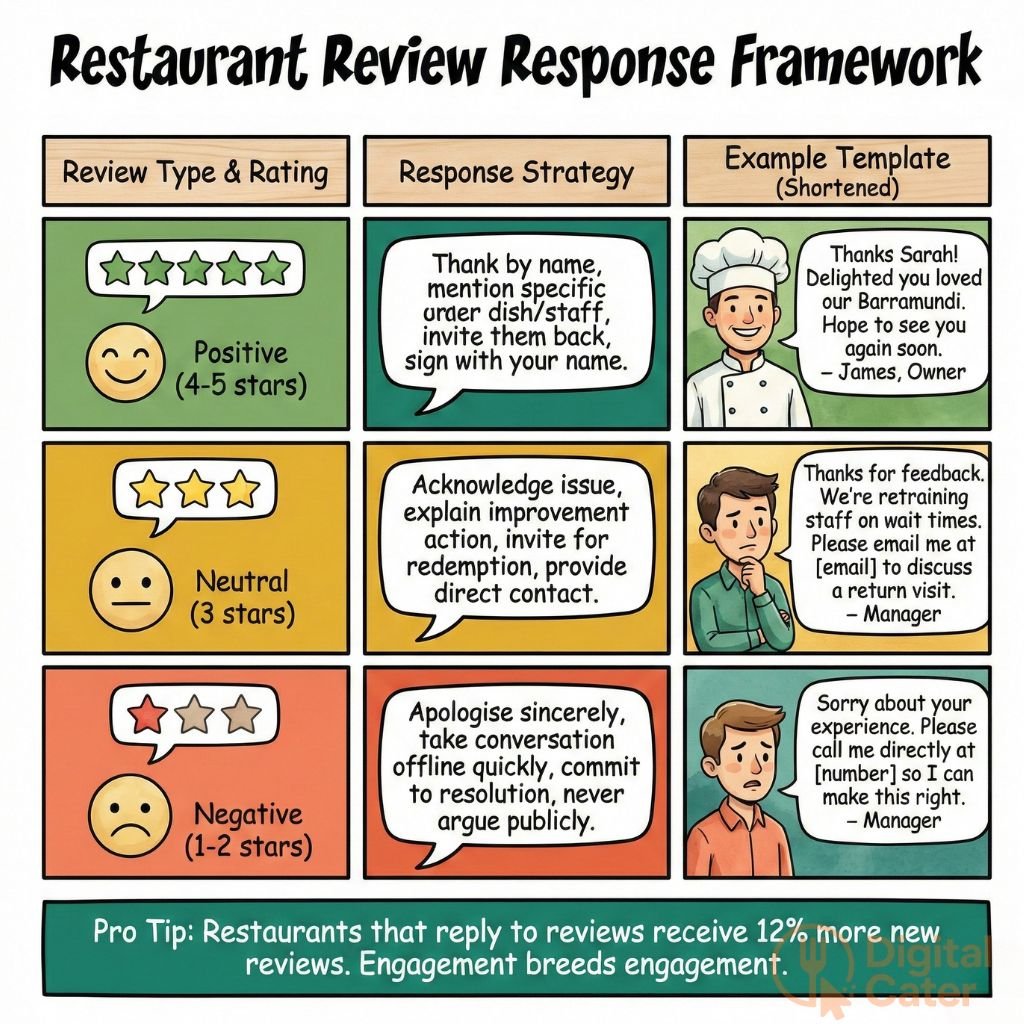
Reviews heavily influence dining decisions and revenue. Focus on major platforms: Google, Yelp, TripAdvisor, and Facebook. Request reviews after positive experiences using simple methods like QR codes. Train staff to ask personally. Respond to all reviews promptly with appropriate templates—thank positive reviewers, address neutral concerns, and resolve negative experiences offline.
Why Reviews Matter
Ninety-four per cent of diners read reviews before choosing a restaurant. A one-star rating increase translates to 5-9% revenue growth. Reviews influence both customer decisions and Google rankings simultaneously.
Focus on these platforms in order of importance: Google (primary), Yelp, TripAdvisor, and Facebook. Quantity, quality, and recency all matter. You need consistent flow, not just old high ratings from 2019.
Getting More Reviews Strategy
Perfect timing: Ask immediately after positive experiences or 2-3 hours later via email. Strike whilst satisfaction peaks.
Frictionless process: Create QR codes linking directly to your Google review page. Place them on receipts, table tents, and menus. Remove every possible barrier.
Staff training: Personal requests from servers convert three times better than automated emails. Train your team to ask satisfied customers specifically.
Email automation: Set up triggers that send review requests 24 hours after visits. Include direct links in the message.
Ethical incentives: Run monthly prize draws for reviewers. Never offer direct payment for reviews—it violates platform policies.
Respond to everything: Restaurants that reply to reviews receive 12% more new reviews. Engagement breeds engagement.
Review Response Framework
Build Customer Loyalty with Email Marketing
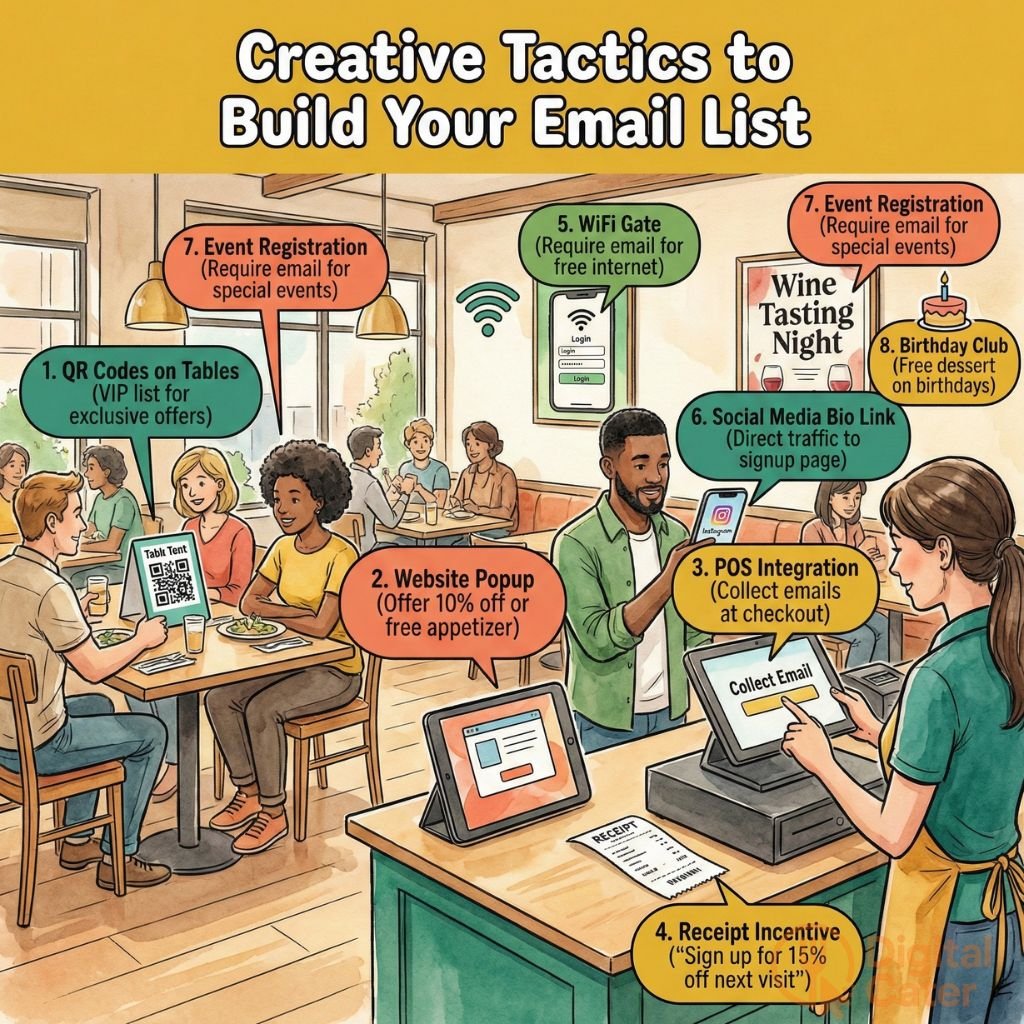
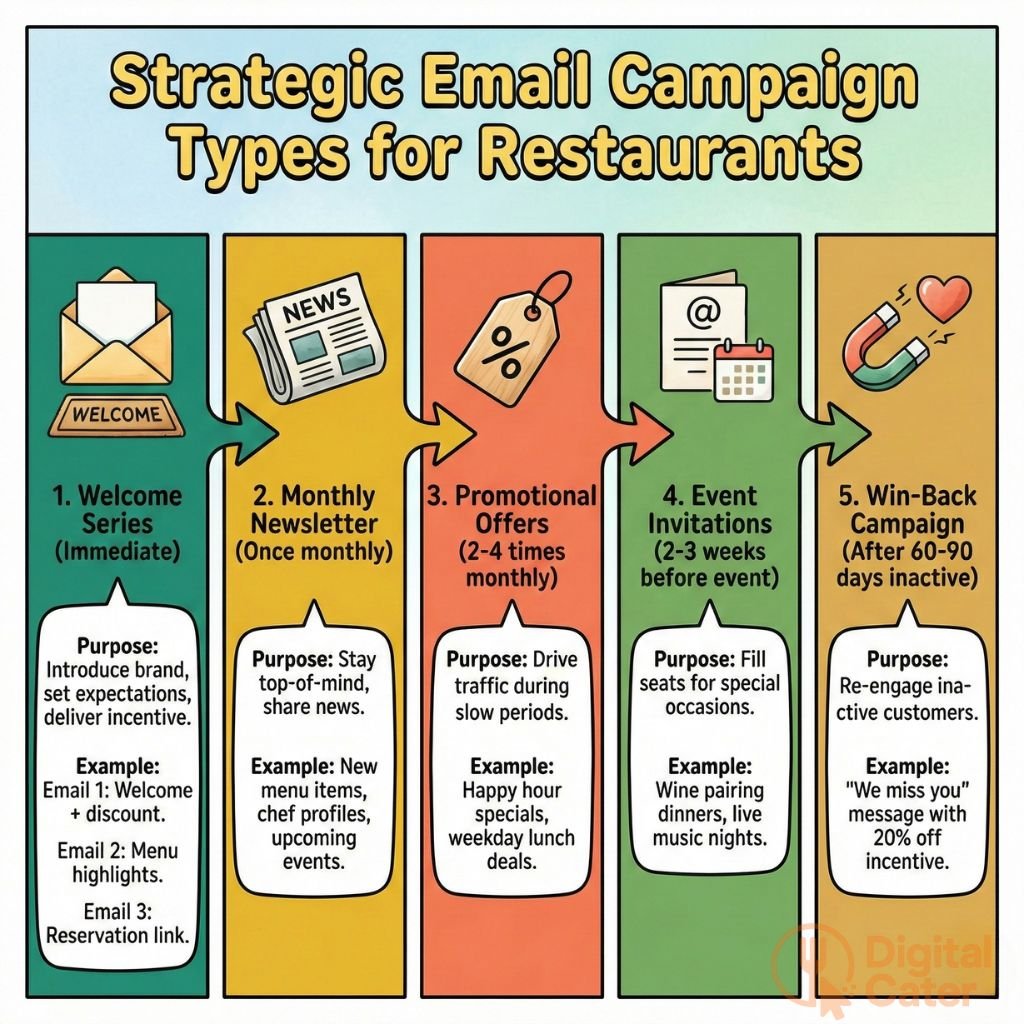
Email delivers exceptional marketing returns whilst giving you direct audience control. Build subscriber lists through website forms, table promotions, receipt offers, and WiFi access. Send welcome messages, regular newsletters, special promotions, event announcements, and re-engagement campaigns. Optimise for mobile devices, craft compelling subject lines, and time messages strategically for maximum impact.
Why Email Matters
Email returns $42 for every $1 spent—the highest ROI of any marketing channel. You own your email list whilst social media algorithms control your reach. Email provides a direct line to customer inboxes.
Target list size equals 10-20% of your annual customer count. Example: 500 weekly customers = 2,500-5,000 subscribers.
List Building Tactics
- Website popup: Offer 10% off or free appetiser for email signups
- QR codes on tables: Invite diners to join VIP list for exclusive offers
- Receipt incentive: Print “Sign up for 15% off next visit” on receipts
- WiFi gate: Require email address to access free internet
- POS integration: Collect emails at checkout for all transactions
- Social media bio link: Direct Instagram and Facebook traffic to signup page
- Event registration: Require email for wine tastings, special dinners, or cooking classes
- Birthday club: Free dessert on birthdays creates compelling incentive
Email Campaign Types
Email Best Practices
Keep subject lines under 50 characters. Create urgency without sounding desperate. “Tonight Only: 2-for-1 Mains” outperforms “Check Out Our Specials.”
Seventy per cent of emails open on phones. Use single-column layouts with large buttons. Test on multiple devices before sending.
Include one clear call-to-action per email. Multiple options confuse recipients and reduce clicks.
Send Tuesday through Thursday between 10am-12pm or 5-7pm. These windows catch lunch planners and dinner decision-makers.
Segment when possible. Lunch customers want different messages than dinner diners. Locals respond to different offers than tourists.
Leverage Social Media to Attract Diners
Select platforms matching your target audience: Instagram for younger diners, Facebook for older demographics, TikTok for youth markets. Share food photography, promotional offers, customer reviews, special events, kitchen glimpses, and team stories. Maintain regular posting schedules, use targeted hashtags, respond quickly to engagement, and encourage customers to share their experiences.
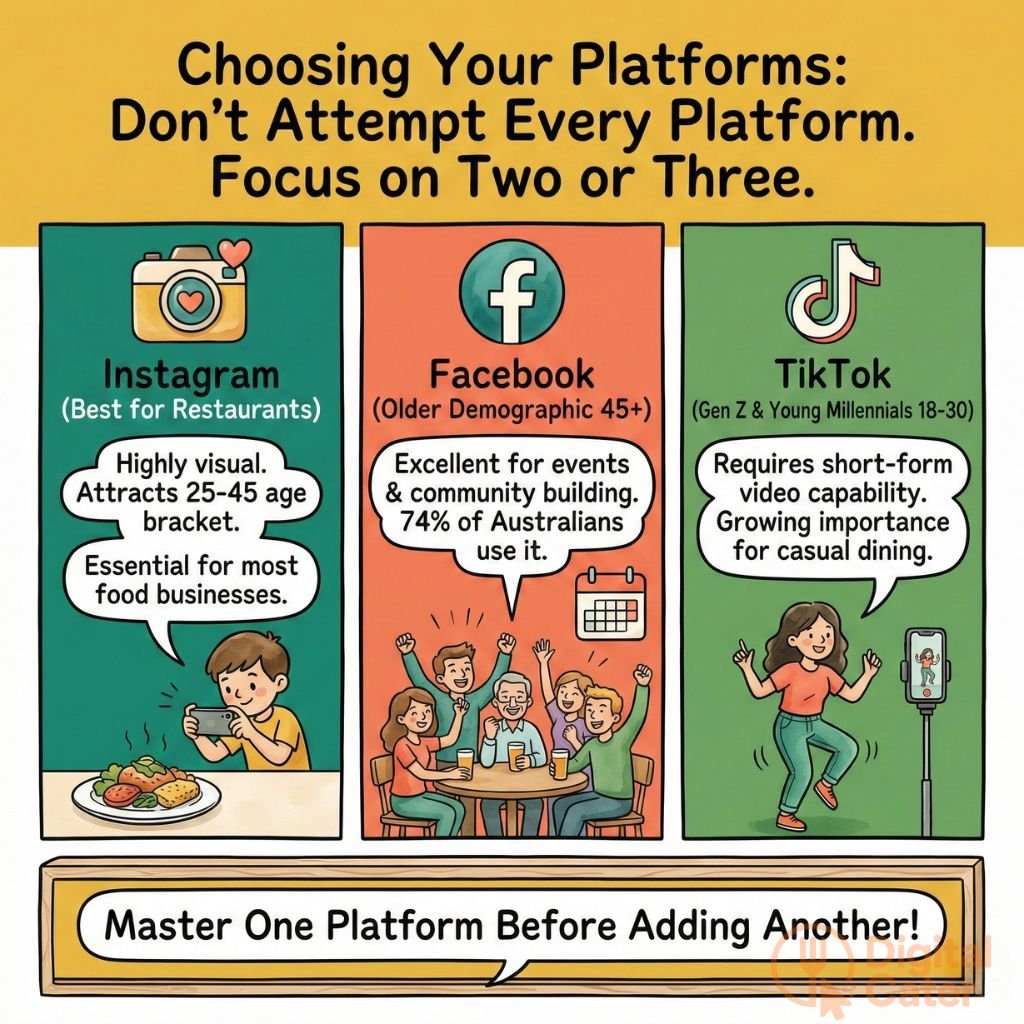
Choosing Your Platforms
Don’t attempt every platform. Focus on two or three maximum. Master quality over quantity.
- Instagram: Best for restaurants. Highly visual. Attracts 25-45 age bracket. Essential for most food businesses.
- Facebook: Older demographic (45+). Excellent for events and community building. Seventy-four per cent of Australians use it.
- TikTok: Gen Z and young millennials (18-30). Requires short-form video capability. Growing importance for casual dining.
- LinkedIn: Only relevant for corporate catering and B2B relationships. Skip otherwise.
- X/Twitter: Declining relevance for restaurants. Skip it.
Platform choice depends on your target demographic and content creation capacity. Master one platform before adding another.
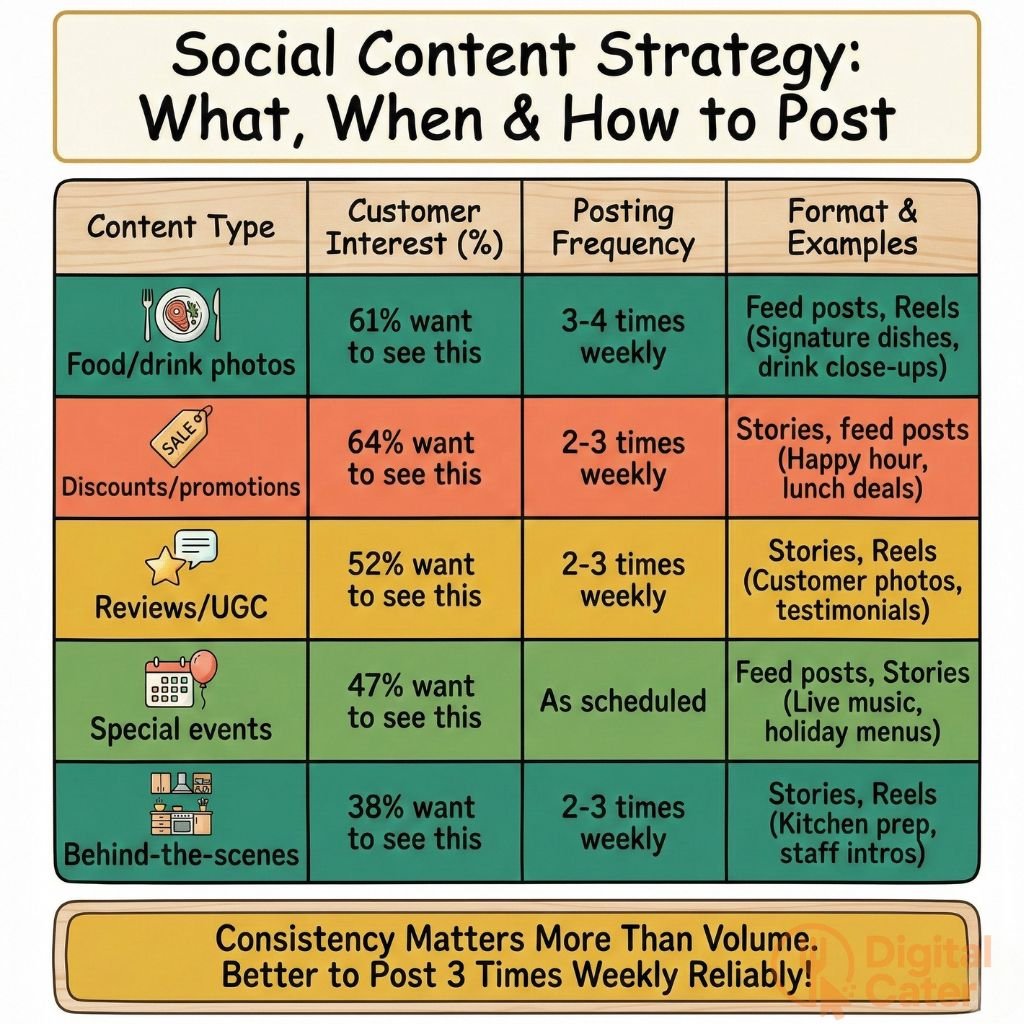
Social Content Strategy
Posting Frequency Guidelines
- Instagram: Publish 4-7 feed posts weekly plus daily Stories and 3-4 Reels weekly. The algorithm rewards consistent Reel posting.
- Facebook: Post 3-5 times weekly. Less frequency required than Instagram. Focus on events and community engagement.
- TikTok: Upload 4-7 videos weekly minimum. The algorithm heavily favours frequent posting.
- Consistency matters more than volume. Better to post three times weekly reliably than seven times one week and zero the next.
- Best posting times: 11am-1pm (lunch browsing) and 6-8pm (dinner planning). Test your specific audience and adjust accordingly.
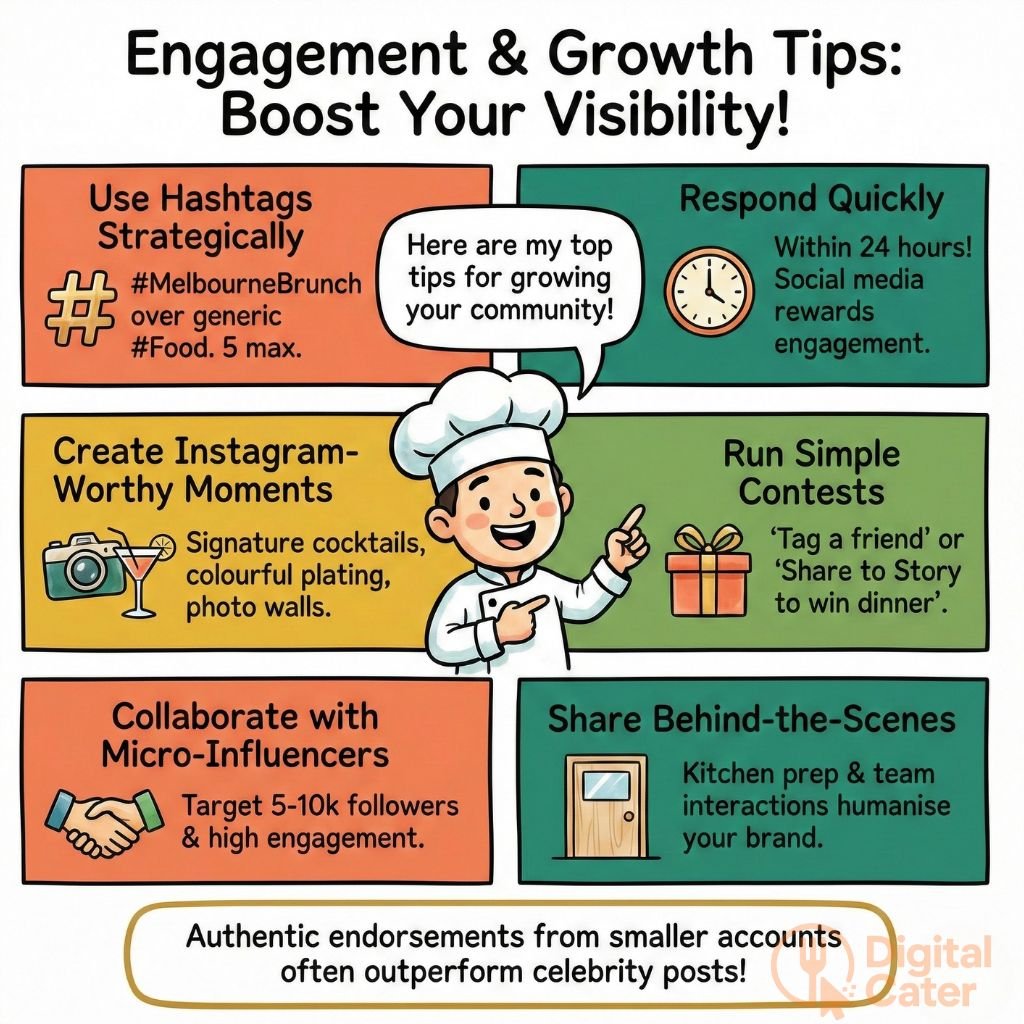
Engagement & Growth Tips
- Use hashtags strategically. Five maximum. Choose specific tags like #MelbourneBrunch over generic #Food.
- Respond to comments and direct messages within 24 hours. Social media rewards engagement with increased visibility.
- Create Instagram-worthy moments in your restaurant. Signature cocktails, colourful plating, and photo walls encourage customer content creation.
- Run simple contests. “Tag a friend who needs brunch this weekend” or “Share this to your Story for a chance to win dinner for two.”
- Collaborate with micro-influencers. Target accounts with 5-10,000 followers and 5-6% engagement rates. Authentic endorsements from smaller accounts often outperform celebrity posts.
- Encourage user-generated content with branded hashtags. Repost customer photos with permission. This provides free content whilst building community.
- Use Story features actively. Polls, questions, and countdown stickers boost engagement and provide customer insights.
- Share behind-the-scenes content regularly. Kitchen preparations, ingredient deliveries, and team interactions humanise your brand.
When & How to Use Paid Advertising
Build organic presence first before investing in paid promotion. Consider advertising when free channels reach capacity, growth needs acceleration, or competition intensifies. Test affordably before scaling. Google Ads reach active searchers, Facebook and Instagram build visual awareness, Yelp targets local intent. Track returns carefully and adjust spending based on performance.
When Paid Ads Make Sense
Paid advertising isn’t necessary for every restaurant. Build organic channels first. Consider paid promotion when you’ve maximised free options and need faster growth, have a specific event or launch requiring visibility, operate in competitive markets with limited organic reach, or can afford $300-500 monthly for testing.
Start with consistent product and service quality. Don’t advertise to fix fundamental problems like poor reviews or inconsistent food quality. Marketing amplifies what exists—good or bad.
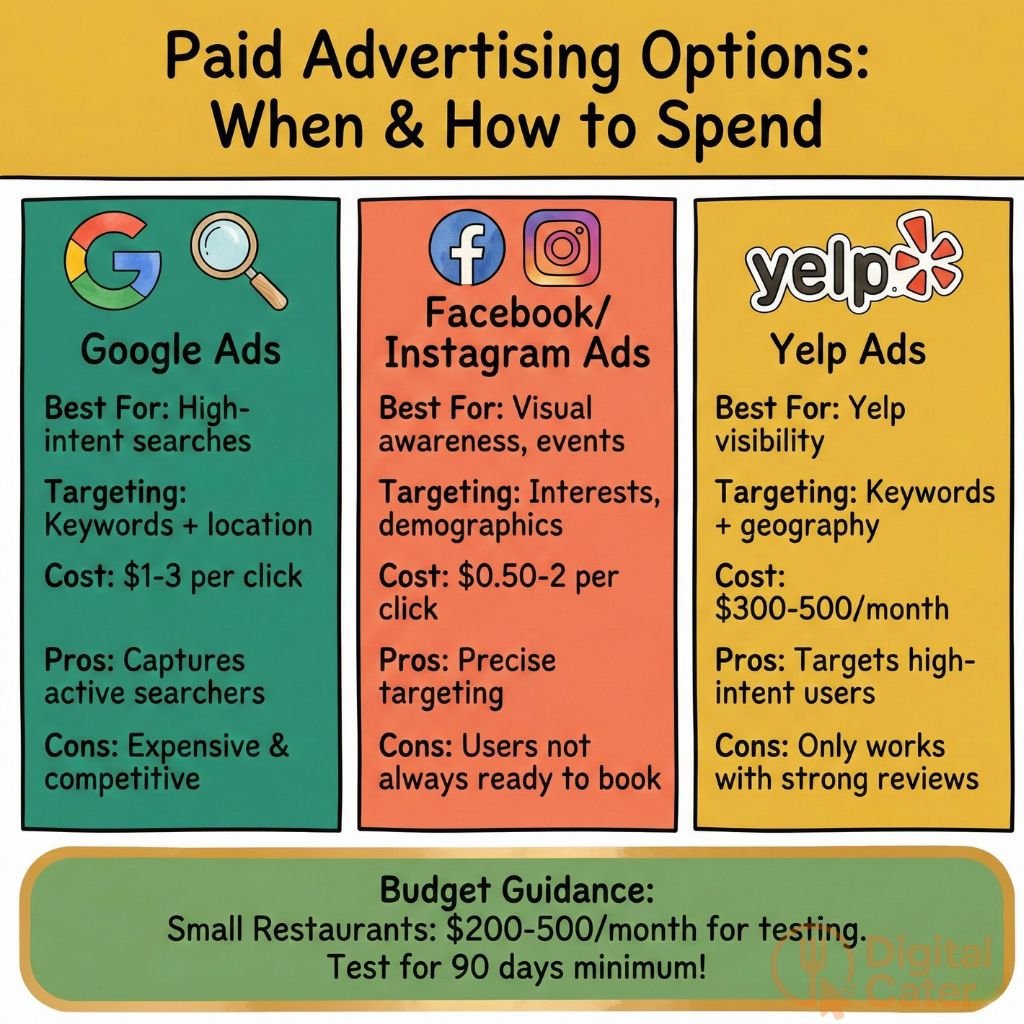
Paid Advertising Options
Advertising Budget Guidance
- Small independent restaurants: $200-500 monthly for testing.
- Multi-location operations: $1,000-3,000 monthly across locations.
- Rule of thumb: allocate 3-5% of monthly revenue to marketing. Test for 90 days minimum before judging effectiveness.
- Track return on ad spend (ROAS). Aim for 3:1 minimum—every $1 invested returns $3 in revenue.
Track Performance & Optimise Results
Consistent measurement drives continuous improvement. Monitor website traffic, local profile views, social engagement, email effectiveness, review frequency, and revenue patterns regularly. Use analytics tools and platform insights. Compare results against industry standards. Identify successful tactics, fix underperforming areas, test systematically, and shift resources towards highest-performing channels for growth.
Why Measurement Matters
- “What gets measured gets improved.” You can’t identify what works without tracking results.
- Digital marketing’s advantage lies in measurability. Track both marketing metrics (traffic, engagement) and business metrics (bookings, revenue).
- Most restaurants track nothing. Measuring basic metrics immediately gives you competitive advantage.
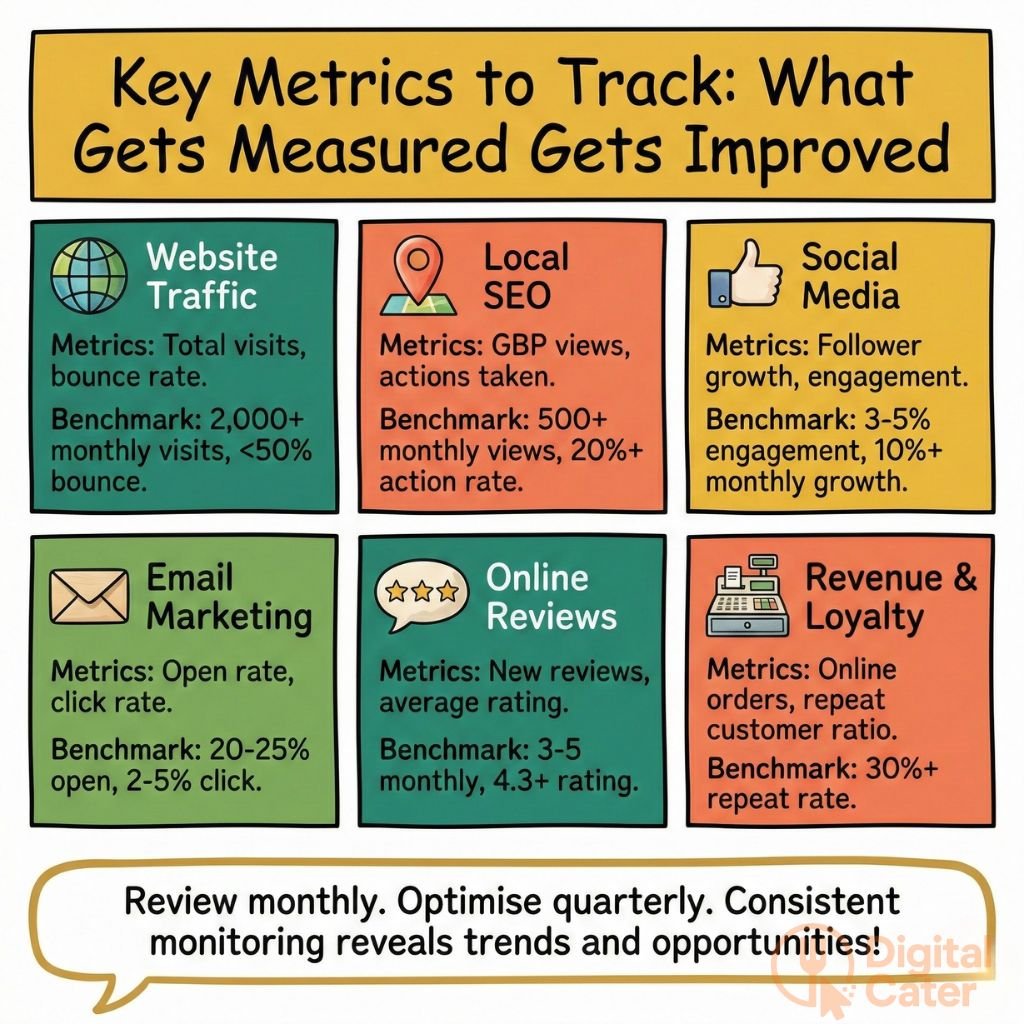
- Review monthly. Optimise quarterly. Consistent monitoring reveals trends and opportunities.
Key Metrics to Track
Optimisation Actions
- Identify top performers: Which posts, emails, or ads generated most engagement? Double down on what works.
- Fix underperformers: High bounce rate suggests slow site or poor mobile experience. Low email opens indicate weak subject lines.
- A/B test systematically: Change one variable at a time. Test subject lines, posting times, or ad images separately.
- Reallocate resources: Shift time and budget from low performers to high performers. Pause campaigns that don’t justify their cost.
- Document learnings: Maintain a spreadsheet tracking what worked, what didn’t, and why. Build institutional knowledge over time.
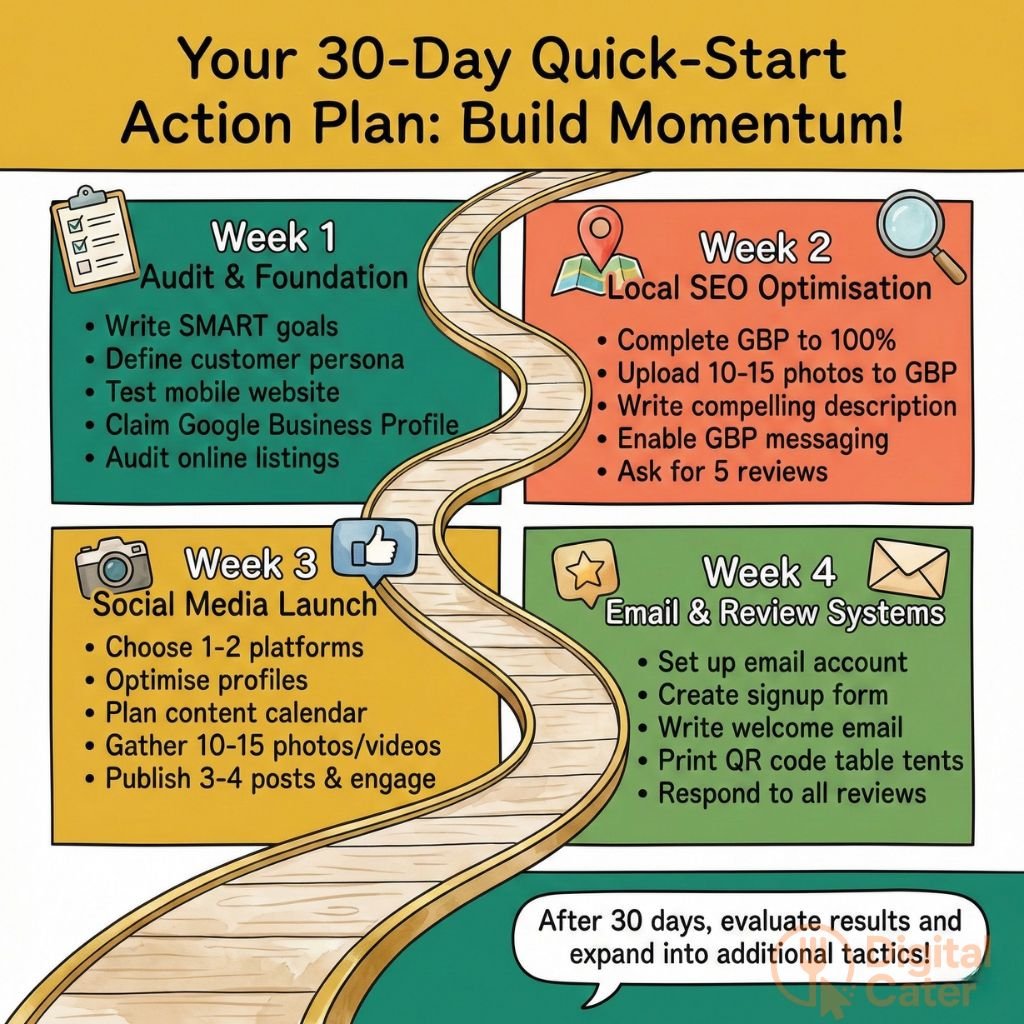
Your 30-Day Quick-Start Action Plan
Implement systematically across four focused weeks. First week: audit current presence and establish foundations. Second week: optimise local search visibility. Third week: launch social media with planned content. Fourth week: create email systems and review collection processes. Build momentum through achievable progress before expanding into additional strategies and channels.
Getting Started
Feeling overwhelmed by eight strategies? That’s normal. Don’t attempt everything simultaneously.
This 30-day plan focuses on highest-impact fundamentals. Invest 3-5 hours weekly. Build momentum through small wins.
After 30 days, evaluate results and expand into additional tactics.
Week 1: Audit & Foundation
Tasks (4 hours total):
- ☐ Write two SMART goals for your restaurant (30 minutes)
- ☐ Define one target customer persona (30 minutes)
- ☐ Test website on mobile devices and note issues (30 minutes)
- ☐ Claim and verify Google Business Profile (1 hour)
- ☐ Audit all online listings for accuracy (1 hour)
- ☐ Install Google Analytics on website (30 minutes)
Week 2: Local SEO Optimisation
Tasks (4 hours total):
- ☐ Complete every GBP field to 100% (1.5 hours)
- ☐ Upload 10-15 photos to Google Business Profile (1 hour)
- ☐ Write compelling GBP description with location keywords (30 minutes)
- ☐ Enable GBP messaging and commit to 24-hour responses (15 minutes)
- ☐ Ask five satisfied customers for Google reviews (1 hour)
Week 3: Social Media Launch
Tasks (5 hours total):
- ☐ Choose one or two platforms based on target audience (15 minutes)
- ☐ Create or optimise social media profiles (1 hour)
- ☐ Plan content calendar for two weeks (1.5 hours)
- ☐ Create or gather 10-15 photos and videos (1.5 hours)
- ☐ Publish 3-4 posts and engage with responses (45 minutes)
Week 4: Email & Review Systems
Tasks (4 hours total):
- ☐ Set up email marketing account (Mailchimp or similar) (30 minutes)
- ☐ Create website email signup form with incentive (1 hour)
- ☐ Write and schedule welcome email template (1 hour)
- ☐ Print QR code table tents linking to Google reviews (30 minutes)
- ☐ Respond to all existing reviews across platforms (1 hour)
Conclusion
Digital marketing isn’t optional anymore—it’s essential. You don’t need massive budgets. You need consistency.
Focus on fundamentals: optimise your website, dominate local search, encourage reviews, build your email list, and maintain active social presence. These seven strategies drive 90% of restaurant marketing results.
The biggest mistake? Trying everything and quitting when results don’t appear overnight. Better to master one channel thoroughly than dabble in five poorly. Follow the 30-day plan. Expand after establishing foundations. Marketing represents a marathon, not a sprint. Three to five hours weekly creates significant impact over time.
Start today with Week 1. Bookmark this guide and reference it monthly. Your restaurant deserves to be found by customers actively searching for what you offer. Take the first step now.